

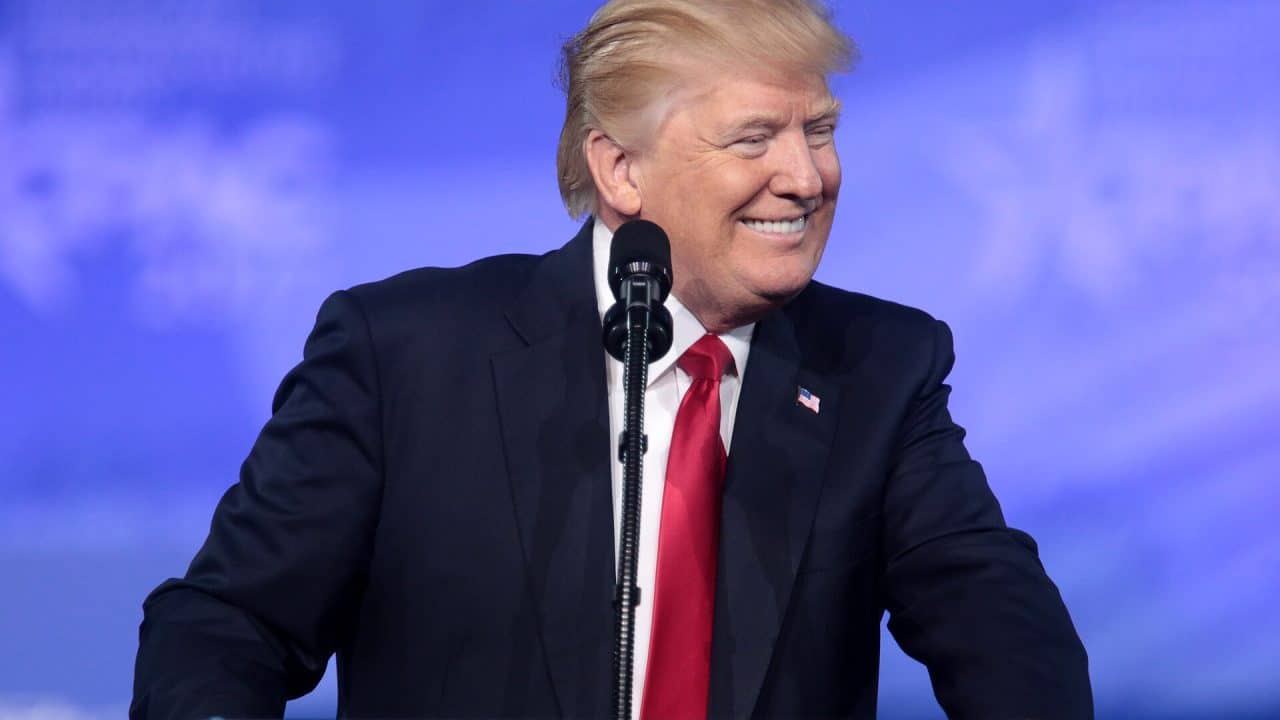
 Donald Trump by Gage Skidmore is licensed under CCA-SA 2.0 Generic License
President Donald Trump has taken a firm stance against discriminatory European digital services taxes (DST) around the world.
On June 26, Trump warned that he would levy a 100% tariff on all imported goods from any country that imposes a DST. This action would fall under Section 301 of the 1974 Trade Act, which grants the President broad retaliatory power against unfair and harmful foreign trade practices.
DSTs represent a grave threat to digital commerce and intentionally target U.S. businesses. Because many DSTs are designed with revenue thresholds, U.S. tech giants, such as Meta, Alphabet, Apple, and Microsoft, are often the only companies that have to pay. A report from the Tholos Foundation found that the vast majority of DST-paying firms in Spain and Turkey were American and over 90% of the United Kingdom’s DST revenue came from U.S. firms. The onslaught of digital taxation now costs U.S. tech firms nearly three billion dollars every year.
Yet, the affected businesses will not simply absorb the cost. Instead, they have historically raised marketplace fees, advertising charges, and App Store commissions. DSTs are therefore a backdoor tax on digital activity, not merely on corporate revenue. Americans should remember that whenever European lawmakers opine about making U.S. tech giants “pay their fair share,” the real cost is borne by everyday consumers.
DSTs also violate traditional principles of taxation that have defined the Western social contract for centuries. The justification for taxation has usually rested in a mutually beneficial relationship between the state and the citizen, where the people sacrifice some of their wealth for state protection while still maintaining a voice in the political process. In the case of DSTs, however, companies whose entire institutional infrastructure exists and was born in the U.S. have no political representation in any European country.
DSTs reflect a new and distorted approach to taxation rooted in the Organization for Economic Cooperation and Development’s “Pillar One” framework, which seeks to shift taxing authority from where value is produced to where goods and services are consumed.
The President’s announcement came soon after the E.U. mused about imposing a bloc-wide DST, drawing inspirationfrom Austria, Denmark, France, Hungary, Italy, Portugal, Spain, Switzerland, and the United Kingdom––all of which have implemented DSTs in recent years. Trump’s tariffs would supersede the U.S.-EU trade deal reached last year, which promised to promote a much fairer bilateral trade relationship.
Tax-hungry European lawmakers seem to have forgotten that the U.S. provides a significant defense umbrella for the continent, with U.S. military spending being indispensable for funding the North Atlantic Treaty Organization. Continuing to impose unjust taxes on U.S. digital innovation is not the behavior of good allies. By levying discriminatory DSTs, Europeans sabotage not only their own commerce, but their security..
Unfortunately, Europe is not the only home of DSTs, with similar efforts underway in Canada and Australia. The unchallenged viral spread of these taxes has only made their danger more obvious. It was high time the U.S. took serious action.
With the threat of huge tariffs on European economies, President Trump has shown bold leadership in protecting American interests. Unjust European taxation inspired a revolution in America 250 years ago. Americans stood against it then, and they must do the same now.