
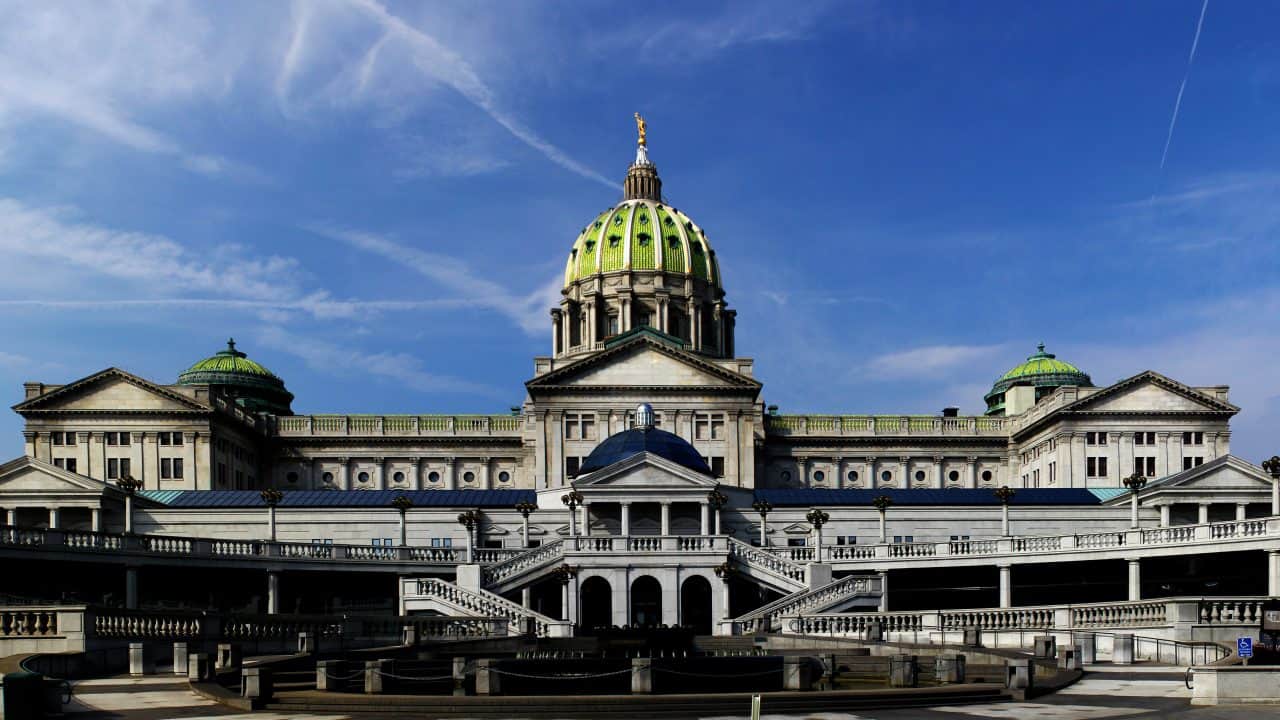
 Pennsylvania State Capitol by Kumar Appaiah is licensed under CC.
Last week, Governor Josh Shapiro signed Pennsylvania’s newest budget. Thanks to Republicans in the State Senate, the state’s new budget includes no tax hikes.
However, the $50.85 billion budget — a 3.72% spending increase from last year — includes several provisions that could prove worrisome for fiscal stability.
Perhaps the most notable of spending increases in the new budget is in education. The new budget includes roughly $678 million in increased spending, most of which are earmarked for “adequacy and equity supplements.” During Shapiro’s tenure, education spending has steadily increased by 35%.
However, ballooning spending has not led to better educational outcomes for Pennsylvania’s children. A report from the Commonwealth Foundation indicated in 2025 that “69% of Pennsylvania 8th grade students aren’t proficient at math, and an equal 69% cannot read at grade level, based on results on the NAEP.”
Instead of delivering lifeline scholarships to children trapped in perpetually failing school districts – as promised during his gubernatorial campaign – he line-item vetoed them directly from the 2023-24 budget and has instead pushed more redistributive spending that has not led to strong educational outcomes.
The budget also includes substantial spending increases for infrastructure, to the tune of $775 million over the next two years. Earmarked for improvements to state-owned road conditions, this substantial funding increase should rightfully be questioned. Pennsylvania has one of the highest gas taxes in the nation, which increases automatically. Road conditions should be great and there should be little need for added spending, yet the Annual Highway Report gives the state the 20th ranking in terms of maintenance distributions, which accounts for expenditures related to repairing and repaving roadways, filling potholes, and boosting structural integrity of bridges and other road fixtures.
Even though the federal Infrastructure Investment and Jobs Act gifted Pennsylvania over $5.2 billion for road improvements, their Annual Highway Report ranking has barely progressed. The state moved its overall ranking from 39th in 2021 to 36th currently. Their rural arterial pavement condition, which describes the quality of two to four lane roads connecting cities, backslid over the same period from 33rd to 37th. Similarly, their score on structurally deficient bridges only moved from 46th to 45th. This indicates that the large infrastructure investment is having a hard time actually reaching pavement in Pennsylvania.
In the face of continuous spending increases, Pennsylvania faces a looming structural debt disaster. To avoid dipping into the state’s rainy-day reserve fund, the budget includes a cycle roll — a delay of payments — to Medicaid managed care organizations. This delayed payment schedule account for two months’ worth of payments, which are worth about $1.3 billion each. Democrats blame Republicans for not wavering on dipping into reserve funds, but Republicans in the state understand that this is representative of a larger policy debate in the Capitol. As Americans for Tax Reform Founder and President Grover Norquist says: “The deficit is the symptom of the disease.”
Strong conservatives in the Keystone State understand this principle very well. Rather than compromise on conservative fiscal values by dipping into the rainy-day fund or allowing for tax hikes, they have forced the Democrats — who occupy the governorship and control the state House — to drop some of their most damaging fiscal demands.
Americans for Tax Reform commends Pennsylvania Republicans for standing firm against tax hikes, while voicing continued concerns that the state’s fiscal position is becoming more precarious.