
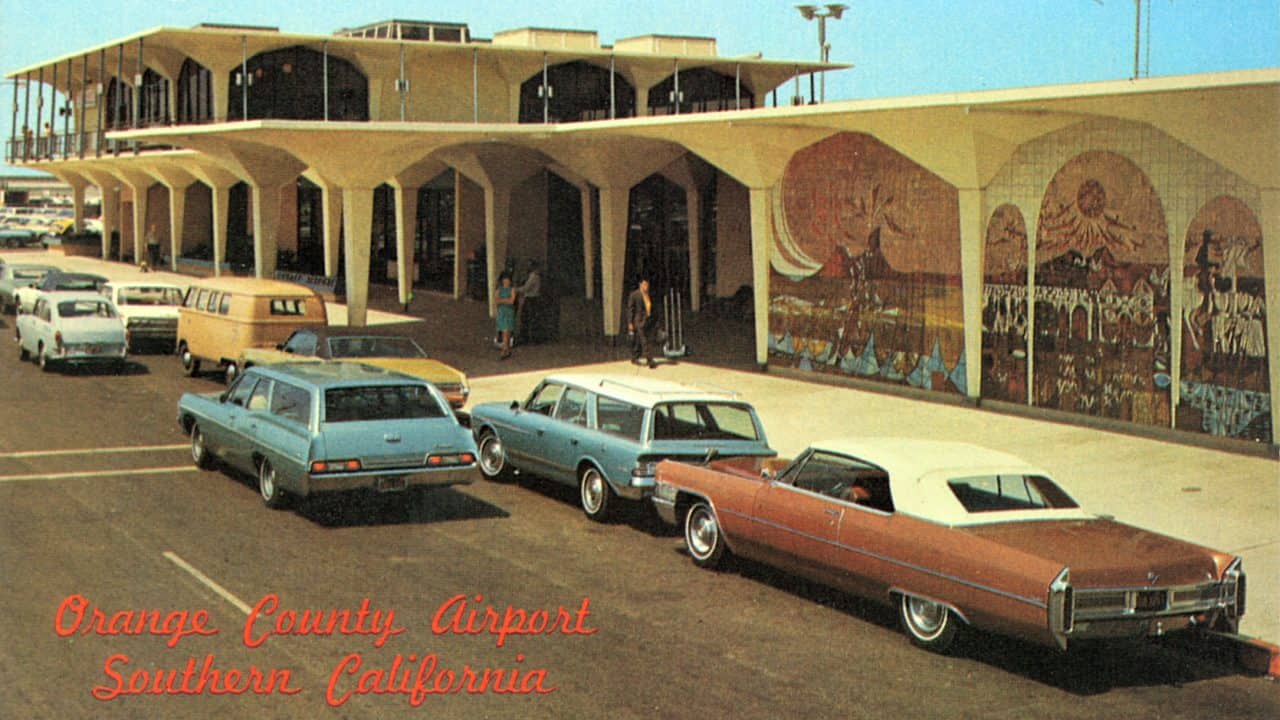
 Orange County Airport postcard, 1970s by Orange County Archives, licensed under CC
For the past 40 odd years, Republicans have viewed California as an untouchable leftist stronghold. Informed people from all sides generally deride the thought of Republicans someday regaining control as, at best, wishful thinking. November 5th promised something different.
The naively optimistic suggestion that California may be shifting rightward has now, impossibly, borne fruit.
On the presidential level, Trump outperformed the most supposedly accurate polls by a whole five points: 33% to 38%. The margin of error for California on the RealClearPolitics (RCP) polling average was around 3 points. Sure, Trump regularly outperforms the polls, but this wasn’t a standard overperformance — it was as close, as far as California is concerned, to absolute statistical destruction.
For those who think this claim is hyperbolic: the devil is in the details. While polling has been inconsistent on the whole, they’ve always been essentially right on the money when it comes to California. A difference of four points isn’t that far off compared to some of the poll’s worst blunders, but it’s light years away from nearly zero.
However, one instance where Trump beats the margin of error could be a fluke.
Fortunately, that’s not all we’re working with.
California had the most competitive congressional races of any state this year. Most Democrats attempting to unseat Republican incumbents failed, which isn’t in and of itself encouraging, until one realizes that these districts have significant Democrat voter majorities – over 10 points in some cases – and all of the competitive seats with Republican incumbents voted for Biden in 2020.
Moreover, Republicans flipped three seats in the state legislature this year, one of which was an incumbent Democratic senator. a feat that the California GOP hasn’t achieved since Reagan. The Republican victor, Senator-Elect Steven Choi, said after winning that “Almost nobody believed in me other than myself.”
It would make sense not to believe in him. Like in the congressional races, most registered voters in his district are Democrats.
The other two Republicans who flipped Democrat seats, Assemblyman-elect Jeff Gonzalez and Letica Castillo won in areas with even larger Democrat majorities and significant Latin American populations. Following the national trends, where Trump saw increases in Black and Latino supporters, these traditionally Democrat populations in California are leaning more right-wing by the year, largely due to cultural differences with the increasingly out of touch Democrat party.
The fact that Republicans are winning in areas with such high Democrat voter registrations could be explained in two different ways. The first is that Democrats aren’t voting. Despite reduced turnout since 2020 (as was the case nationwide), Democrat turnout remains around 73% in California, higher then most states.
The more interesting possibility, which proved true in the general election, is that Republicans are winning in populations that either traditionally don’t vote, or don’t vote Republican. Both of these possibilities can be true at once; however, 2020 was a fluke when it comes to voter turnout. Democrats cannot expect the same level of turnout again, and this reality was reflected in 2024. If Republicans can learn to consistently tap into these once unreliable populations, as they seem to be doing most prominently with Latinos, then they have an edge that they can continue to sharpen in future elections, whereas the Democrats do not.
To drive the point home, progressive ballot measures like Proposition 32, which attempted to raise California’s minimum wage to $18 an hour, lost by a thin margin. There’s reason to believe this failure, more than other progressive failures, is representative of an ideological shift. Indeed, no state has voted against a minimum wage increase since 1996.
If you buy into liberal principles about minimum wage, there’s no good reason in this case to vote against raising it. California was the first state to bring it to $15 in 2022. Democrats, even moderate ones, believe that the policy not only comes with no negative consequences but actually has a positive effect on the economy.
The normal talking point that local businesses can’t afford the pay increase doesn’t obviously apply in this case. Many entry level jobs are already paying around this much, even in states with a much lower cost of living than California. Many municipalities have actually set their minimum wage to upwards of $19. Thus, $18 does not seem unreasonable, especially to a typical liberal voter. Moreover, fast food jobs already have a $20 minimum wage in CA, potentially mitigating some concern over rising prices.
Either liberals have drawn a line, which they are notoriously bad at doing, and realized that the minimum wage does, in fact, have an upward effect on prices (in which case their worldview should collapse), or different populations are voting in greater numbers. Either case is good for Republicans, provided that they can keep the party message focused on whatever caused this discrepancy.
Most damningly, registered Democrats have been more likely than Republicans to leave California outside the past 2-5 years, with college educated millennials leaving at much higher rates, as well as lower income households who can’t afford the rising property costs, even with the tax protections afforded by Proposition 13. High income households who can work from home are the only demographic where the exodus is reversing, and they also happen to be the most likely demographic to register as Republican, with low-income voters being the most likely to vote Democrat.
In other words, at precisely the time in which California’s booming Latino population is beginning to vote conservative, Democrat mainstay populations are fleeing the state en masse. It doesn’t take a data scientist to realize where that population trend might be pointing, electorally speaking.
If there’s anything characteristic of the Californian electorate over time, it’s rapid change. In the not-so-distant past, the state’s Hispanic population used to be majority Republican. No one expected the state to vote blue after Reagan: on the surface, it seemed solidly red, but something important happened under the surface.
What took place in November may be a sign of another, deeper change stirring deep under the surface. Only time will tell whether the signs from 2024 will ultimately translate to Republican wins in 2026 and beyond, but one fact has remained true across all of history: the pendulum always swings back.
