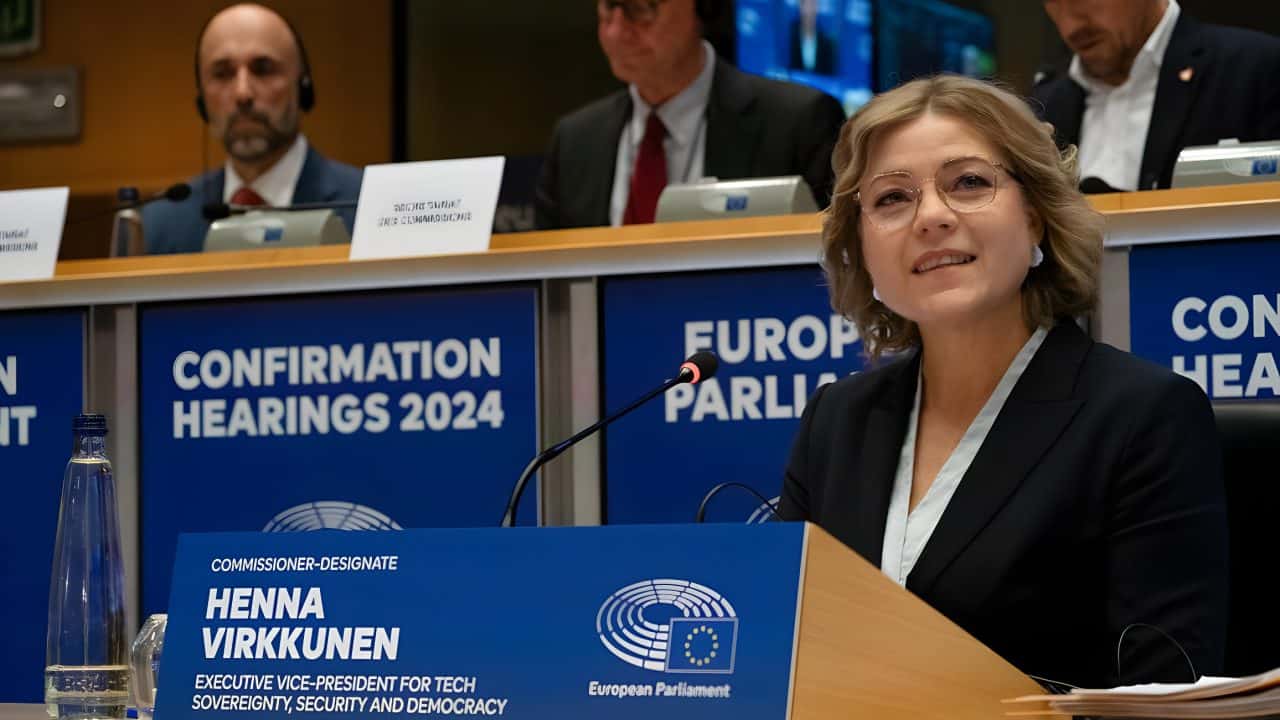
 Executive Vice-President of the European Commission for Technological Sovereignty Henna Virkkunen is licensed under Creative Commons.
Elon Musk’s social media platform X has become the first victim of the European Commission’s Digital Services Act (DSA). Under the act, providers of advertising, social media, search engines, platform hosting, and numerous other digital services crucial to modern online infrastructure are subject to unreasonable reporting requests, enforced by the whims of European regulators. Similar to its sister bill the Digital Markets Act (DMA), the DSA represents a direct attack on American business in Europe and a palpable threat to free speech via jurisdictional overreach.
The EU’s fine against X saw the social media company ordered to pay €120 ($140) million for violations of the law. X’s crime? Breaching the DSA’s privacy requirements by refusing to decrypt and share troves of user data for government use… which would have directly compromised the personal information of X’s 200–300 million daily users.
The fine was further justified by X’s efforts to prevent private data collection. The company explicitly bans data scraping (the use of scripts to automatically collect information) in its terms of service. They argue that mass scraping requires servers to process thousands of site redirects per second, resulting in slowdowns similar to those associated with malicious Distributed Denial-of-Service (DDoS) attacks. Intended to disincentivize the loose handling of private information, in reality the DSA’s first real application has punished internal encryption while degrading the user experience of X.
Passed in 2022, the DSA went into full effect in February 2024, meeting little resistance from the Biden administration, despite outcry from the private sector and free speech watchdogs. In July of this year, the House Judiciary Committee published a report detailing the harmful effects of the DSA on U.S. business interests and free speech. Core to their concern is Brussels’ loose definition of “harmful content” that companies are mandated to remove from platforms.
Due to the ambiguous nature of its definition, European regulators are free to make politically motivated, arbitrary rulings targeting American companies — as seen with X. Worse, the European Commission expects these requirements to be adopted into worldwide terms of service, turning the DSA from a concern for European business, to a global threat to political speech with House Judiciary labeling it Europe’s primary “censorship tool.”
Despite being implemented on a similar timeframe, the DMA has been used in a similar way to target American companies, but to a greater extent. Exploiting arbitrary terminology, the DMA has been used to target American companies with extortionate fines, hampering their competitiveness. It is estimated that Europe’s over-cumbersome digital regulation will cause American companies to lose out on $2.2 trillion worth of revenue by 2030, primarily due to fees and new compliance costs.
Europe’s regulatory approach has done nothing but damage to businesses and consumers wanting to maintain security standards and the user experience. Continued support from American lawmakers and private businesses to call out Europe’s abuse of digital regulations is crucial in order to combat its illegal use of discriminatory trade barriers and attack of free speech.
