

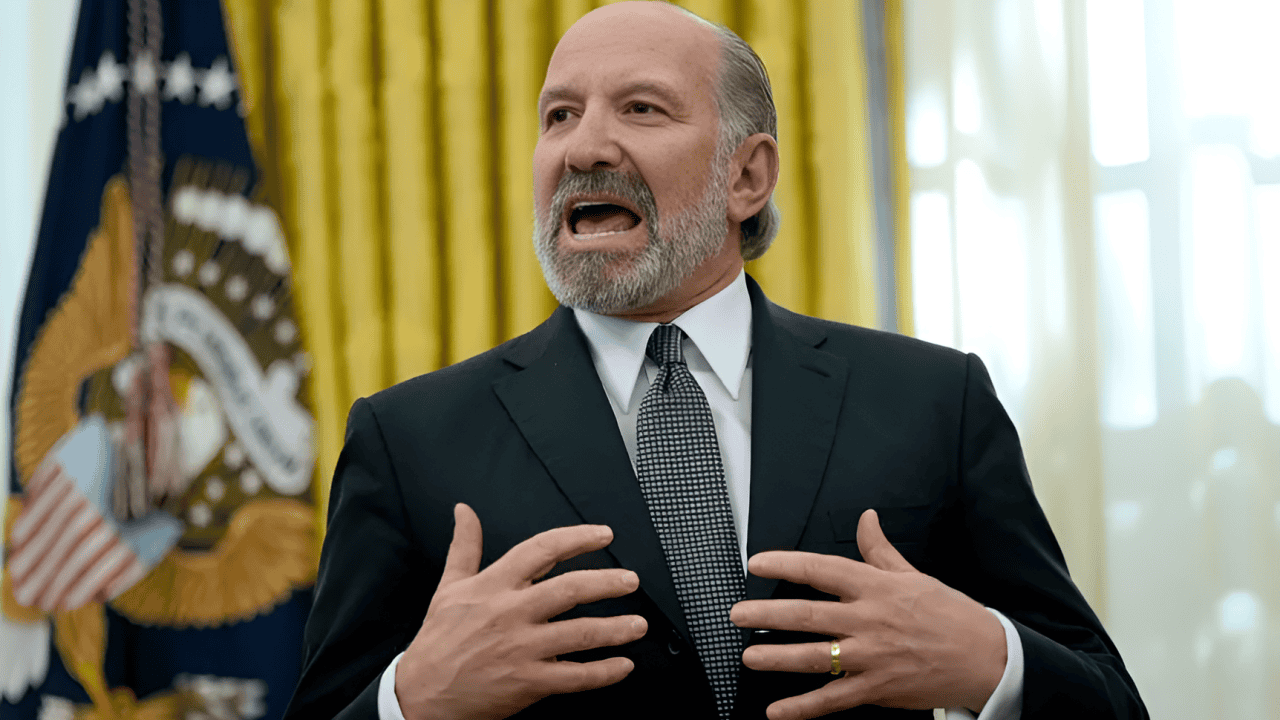
 Howard Lutnick is licensed under Creative Commons.
At a recent EU meeting, European leaders clashed with U.S. Secretary of Commerce Howard Lutnick over growing tension around the EU’s digital regulatory regime. Europe’s regulatory architecture discriminatorily targets American businesses with unfair compliance costs, burdening the rapidly growing tech sector while straining transatlantic relations. Now, Secretary Lutnick has made clear that any future trade must be conducted in the absence of these rules, demanding their immediate repeal in exchange for reductions on steel and aluminum tariffs.
The Digital Markets Act (DMA) comprises one of 16 major pieces of legislation constructing one of the world’s most stringent regulatory environments—that at best negligently limits Europe’s most innovative sector, and at worst actively suppresses American economic activity in Europe. Using arbitrary revenue thresholds and often contradictory terminology, European regulators have had free rein to harness the EU’s digital regulations to uniquely target American companies. The cost of compliance adds up. Europe’s regulatory demands are estimated to cost American companies operating in Europe on average $430 million annually per company, totaling $2.2 trillion in lost revenue and a $325 billion reduction in R&D by 2030.
Europe’s digital regulations have become a lingering sore spot in transatlantic relations. The Trump administration has consistently opposed Europe’s discriminatory trade policies but has struggled to achieve real concessions—until recently: In mid-November the European Commission released a proposal for a “Digital Omnibus Package” to simplify requirements and constrain regulators. Shortly after this, French President Emmanuel Macron and German Chancellor Friedrich Merz spoke out against Brussels’ overzealous regulation of innovative industries where Europe increasingly falls behind American and Chinese competitors.
The EU’s digital regulations have not only caused tension with the U.S. but have increasingly fallen out of favor with European leaders. Secretary Lutnick’s pressure, along with broader opposition from the Executive Office, has already played a crucial role in forcing Europe to reverse course on its regulatory regime. Continued support for free and fair-trade practices that demand the end of laws such as the DMA is crucial as the U.S. continues to seek a truly reciprocal trade relationship with Europe that allows mutual prosperity and exchange.