

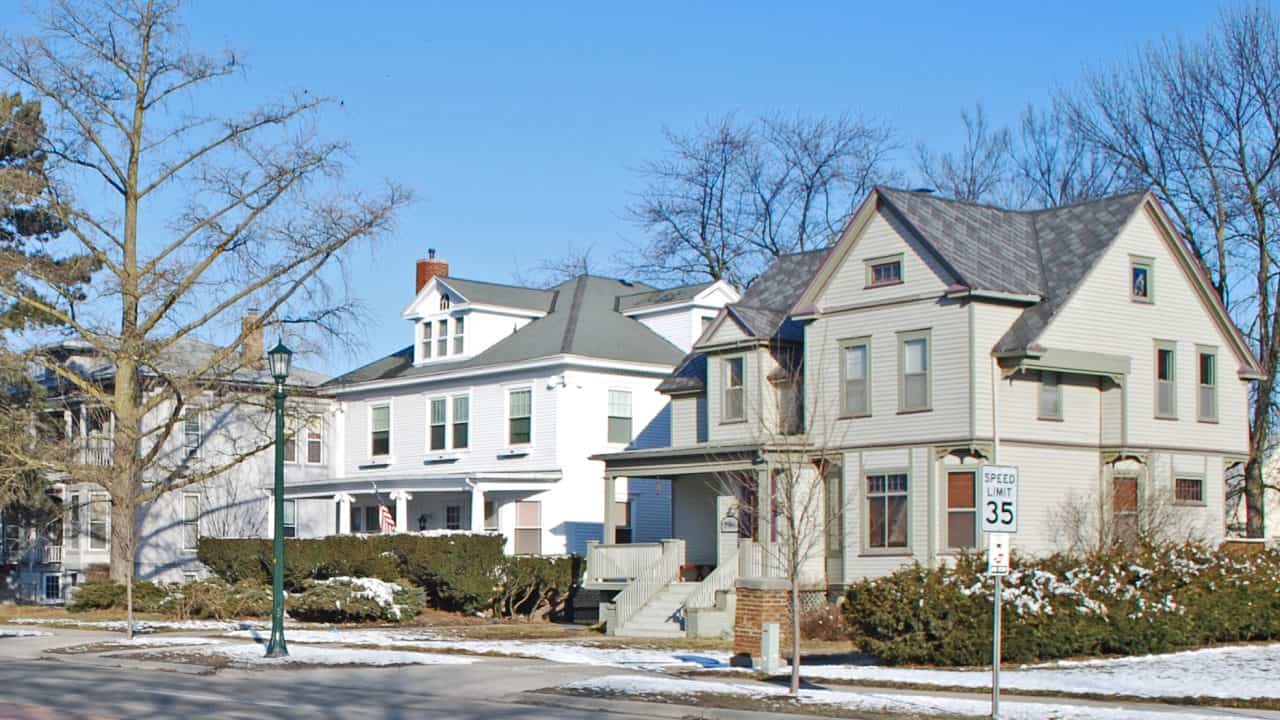
 19th-century houses in Bay City, Michigan by Andrew Jameson is licensed under Creative Commons Attribution-Share Alike 3.0 Unported license
Michigan lawmakers are currently considering the Housing Readiness Package, a series of bills aimed at making housing more affordable by expanding property rights, cutting unnecessary government red tape, and allowing the free market to better respond to the state’s housing needs.
One of the bills included in the package is HB 5530, legislation that would limit one of the most burdensome housing regulations afflicting Michigan: the minimum lot sizes
Under current Michigan law, local governments have considerable flexibility to impose requirements on how much land must be allocated to a detached single-family house. For example, Royal Oak, Michigan, has a minimum lot requirement of 6,000 square feet for a single-family home, while Rochester Hills, Michigan, sets its minimum at 20,000 square feet. The main impact of these minimums is that it constrains the housing supply.
When developers are stuck with excessive lot requirements, the kinds of housing they can build are much more limited. Because the amount of land required to build is increasing, developers are forced to build larger homes and sell them at higher prices to offset the increased costs. The impact is that consumers are left with fewer options, and the types of houses available are moving out of their price range.
HB 5530 addresses this issue by preventing local governments from imposing a minimum lot size greater than 1,500 square feet for a detached single-family residence in their zoning laws. Lowering the minimum gives more flexibility to landowners and developers. No longer are they constrained to building larger, unaffordable homes. They can now build smaller homes that will connect them with Michiganders previously priced out of the market. Whether that is a first-time homebuyer, a retiree, or a low-income individual, this allows the deadweight loss previously incurred by these regulations to be rectified. This helps keep Michiganders in the state, preserve the tax base, support long-term revenue planning, and keep key government functions running.
Housing costs are rising and stretching the budgets of Michiganders across the state, and this is a policy failure. That means that the problem is man-made and can be solved relatively easily. By cracking down on runaway minimum lot requirements imposed by localities engaged in rent-seeking behavior, Michigan can preserve its middle class and ensure the state remains affordable for all, not just entrenched interests.