

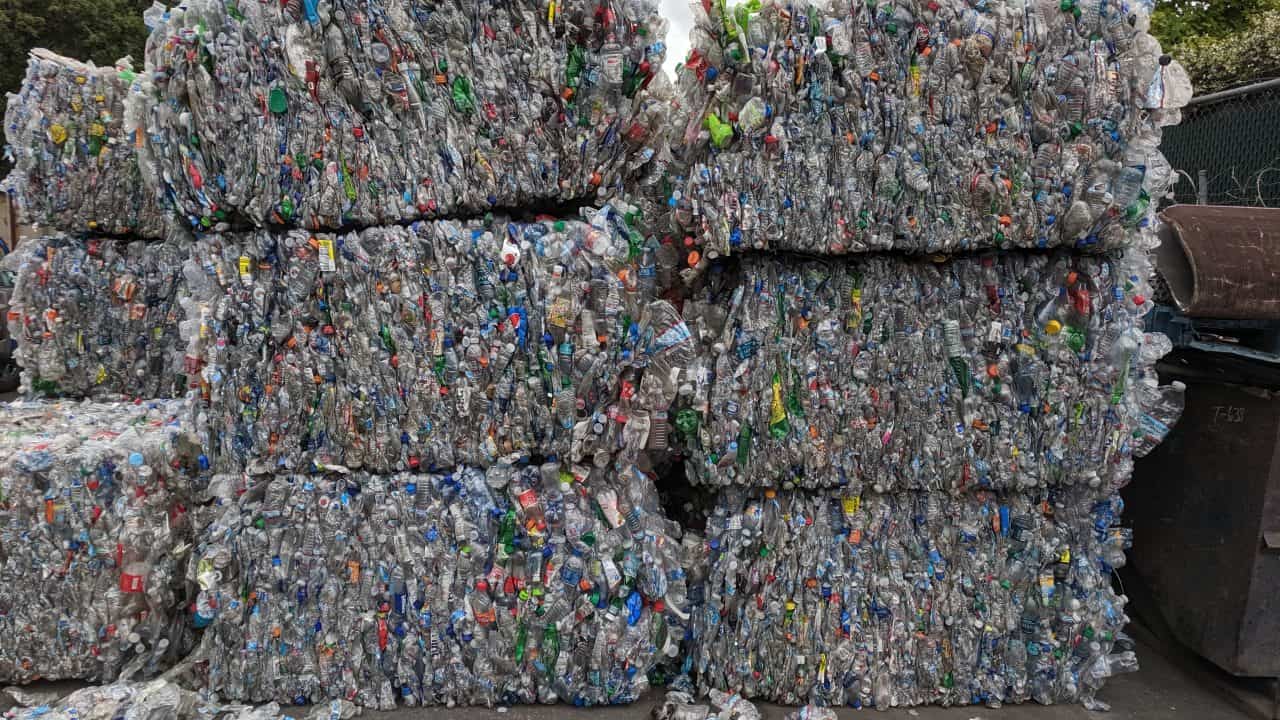
 Bales of crushed PET drink bottles at a recycling facility in San Jose, California. by Grendelkhan is licensed under Creative Commons Attribution-Share Alike 4.0 International license
On July 23rd, California Governor Gavin Newsom took to social media to attack President Donald J. Trump for rising costs. With Newsom willing to be vocal about the affordability crisis, a member of the national press corps (no one in Sacramento would dare) should ask Gov. Newsom, who is widely considered to be a contender for the White House in 2028, why he is making the situation worse by imposing a new regulatory regime that will drive up the cost of most consumer goods.
In 2022, Governor Newsom signed SB 54, which would establish an extended producer responsibility (EPR) program for manufacturers in California. This new regulatory regime will make consumer goods more costly for the working families and taxpayers of California.
California’s EPR law, like those that have been enacted in six other states, requires companies that sell products into California to join a Producer Responsibility Organization (PRO), a private entity that sets a rate schedule based on the material being recycled (e.g., plastic, metal) and collects fees from producers. The PRO then uses the money collected to fund recycling programs.
EPR laws, which originated in Europe, have been gaining traction in the United States in recent years, but that progress has been limited to deep blue states. In 2021, Governor of Maine Janet Mills signed the nation’s first EPR bill for packaging into law. To date, seven states have adopted statewide EPR laws for packaging. With Oregon’s EPR surviving legal challenge on August 27th, expect more EPR bills to be introduced in state legislatures in the coming months.
While EPR proponents are celebrating their court victory in Oregon, they are facing challenges in implementing SB 54 in California.
Because of the complex regulations associated with EPR implementation, costs can easily balloon out of control. Provinces in Canada that implemented EPR laws experienced cost increases of 160% to 250%. According to CalRecycle, California’s Department of Resources Recycling and Recovery, EPR requirements would increase costs to individuals by $116 and to businesses by over $8,000, with an annual cost of $36 billion.
However, CalRecycle’s projections are likely a lowball estimate, given that the study does not fully account for the additional costs of transitioning away from plastic packaging. When all factors are considered, a York University study found that prices increased by 22%, pushing the cost of a representative grocery basket to $342. Products that rely heavily on plastic packaging, such as dairy products and cleaning supplies, experienced the largest price increases. This disproportionately impacts lower-income groups who cannot evade these costs through bulk purchasing.
These administrative and cost burdens do not even lead to positive recycling outcomes. In 2003, Ontario implemented an EPR law, which led to a brief increase in the percentage of products successfully collected, processed, and recycled, but gains fell after 2010 and returned to 2003 levels by 2021. A similar sequence of events unfolded in British Columbia, where the gains peaked in 2020, only to lead to an overall decrease in processing by 2023. This phenomenon is caused by EPRs experiencing concave performance curves, meaning that early gains can be achieved, but diminishing marginal returns occur as program costs grow, reflecting that money could be spent more effectively. Furthermore, like many environmental regulations, producers take advantage of gaps to avoid these burdens. This takes the form of dumping these plastics in developing nations without the infrastructure or regulations to process the waste, leading to worse health outcomes and further environmental degradation.
On August 19th, nearly two dozen Assembly Democrats and state Senator Melissa Hurtado sent a letter to Senate President Pro Tempore Monique Limón that urged a pause in the implementation of SB 54 due to concerns about legislative oversight of the private entity setting the fee. Concerns about SB 54 are not limited to legislative Democrats. The California Teamsters, the union representing many sanitation workers across the state, urged the legislature to make significant revisions to SB 54, stating that the current version was unworkable given its costs, which would lead to wage compression and higher prices.
Others are urging California to take a bigger step and repeal SB 54. The Dairy Institute of California and the California Strawberry Commission, two trade associations in the food space, have urged the legislature to replace SB 54, stating that the current implementation timeline does not give them time to adjust their packaging and will force these producers to transfer cost increases to consumers through higher prices. At a time when California is the most expensive state for groceries in the United States, policies should focus on affordability, not on expensive mandates borne by taxpayers.
Extended producer responsibility laws may be marketed as environmental reform, but in practice, they function as a tax on producers and consumers alike. By piling new administrative burdens onto businesses, empowering opaque private organizations, and raising the prices of everyday goods, EPRs worsen the very affordability crisis elected officials claim to be fighting. Rather than rushing ahead with costly and unproven mandates, lawmakers should pause, reassess, and pursue policies that are transparent, accountable, and affordable for the working families who ultimately pay the bill.