
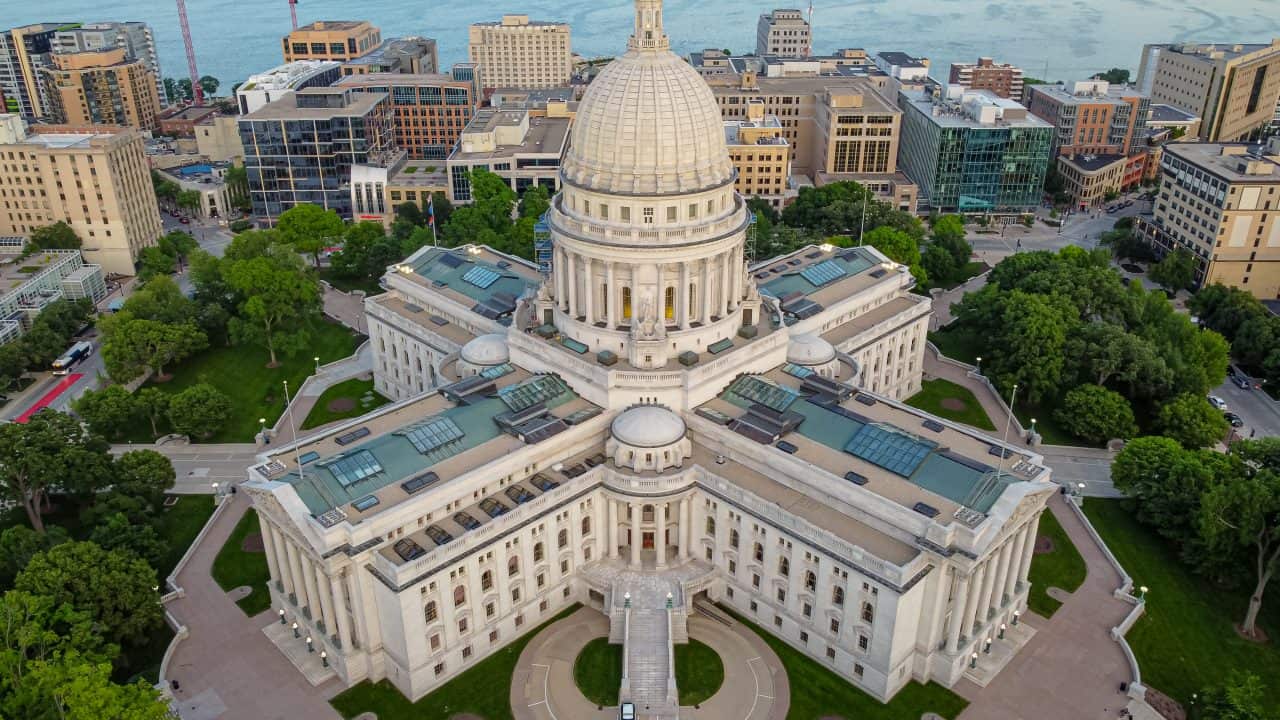
 Wisconsin State Capitol Aerial by Lectrician2 is licensed under CC 4.0
Wisconsin’s partial veto power has produced some of the most absurd examples of executive overreach in the country. The most notorious example, being Governor Tony Evers 400 year property tax hike. This November, Wisconsin voters have the chance to make sure it’s never used to hike taxes on working families again.
Governor Tony Evers struck two digits and a hyphen in Wisconsin’s 2023 state budget, turning a two-year increase in revenue limits, into one lasting more than four centuries.
Wisconsin limits the amount of revenue school districts can raise on a per-pupil basis. The Republican-controlled Legislature’s original provision increased those limits by $325 per student for the 2023-24 and 2024-25 school years.
Evers’ partial veto changed the end date from 2025 to 2425.
That distinction matters for Wisconsin property taxpayers. The veto did not appropriate 400 years of additional state funding. Instead, it extended the annual $325 increase in the amount of revenue school districts are allowed to collect. When state aid does not cover that additional revenue, districts can rely on local property taxes for the difference.
That leaves Wisconsin taxpayers vulnerable to property tax increases for centuries beyond the two-year period approved by the Republican-controlled Legislature, in a state where property taxes are already among the highest in the country.
The Wisconsin Supreme Court upheld Evers’ decision in a 4–3 ruling in LeMieux v. Evers in 2025, concluding that the state constitution prohibits governors from creating new words by deleting letters but does not similarly prohibit them from creating new numbers by deleting digits.
As absurd as the 400-year veto sounds, it is only the latest example of governors creatively exploiting the state’s extraordinarily broad partial veto power.
Wisconsin voters first stepped in during 1990 to prohibit the “Vanna White veto.” Named after the Wheel of Fortune personality famous for revealing letters, the practice allowed governors to veto individual letters within words. By selectively removing letters, a governor could effectively create new words and rewrite legislation letter by letter.
But governors found another loophole.
The “Frankenstein veto” allowed governors to delete words and phrases from multiple sentences and stitch the remaining pieces together to create a new sentence lawmakers never actually passed. Democratic Governor Jim Doyle notoriously used the power in 2005 to redirect more than $400 million in transportation funding.
Wisconsin voters responded again in 2008 by prohibiting governors from combining pieces of two or more sentences to create a new sentence.
Yet governors retained the ability to strike individual digits from numbers, opening the door for Evers’ 400-year veto.
Now Wisconsin voters will have another opportunity to rein in the governor’s veto pen.
Senate Joint Resolution 116 would amend the Wisconsin Constitution to prohibit governors from using the partial veto to create or increase, or authorize the creation or increase of, a tax or fee.
The proposal comes as Wisconsin Republicans and Democrats continue moving in opposite directions on tax policy.
Earlier this year, Wisconsin taxpayers came close to receiving $1.8 billion in relief through an agreement negotiated between Evers and Republican legislative leaders. The package included property tax relief, taxpayer rebate checks, and the elimination of state income taxes on tips and overtime.
Assembly Republicans passed the deal. All 15 Senate Democrats voted against it, killing the proposal.
That followed Evers’ vetoes of billions of dollars in Republican-backed tax relief in previous legislative sessions.
Meanwhile, Democratic gubernatorial candidate Francesca Hong has proposed creating new income tax brackets on high earners, including a top rate exceeding 17 percent.
While Wisconsin Republicans continue pushing to return surplus dollars to taxpayers and lower taxes, Democrats continue moving in the opposite direction.
SJR 116 would not eliminate Wisconsin’s partial veto. It would prohibit governors from using creative deletions to create or increase taxes and fees, regardless of whether the governor is a Republican or Democrat.
Wisconsin voters have already prohibited governors from creating new words and stitching together new sentences with their veto pens.
This November, they will decide whether to prohibit governors from using the same extraordinary power to create or increase taxes and fees.
The Wisconsin Legislature passed a provision designed to last two years.
Tony Evers made it last until 2425.