

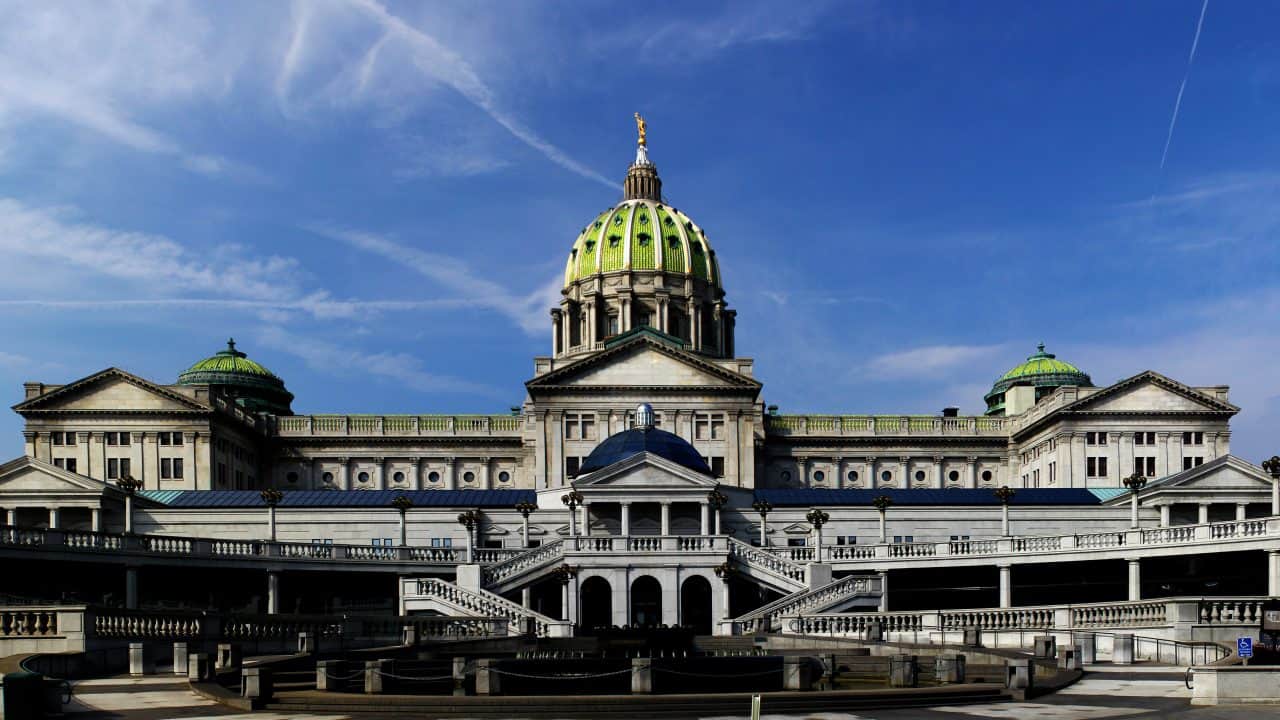
 Pennsylvania State Capitol by Kumar Appaiah is licensed under CC.
One of the lowest flat tax rates in America is facing a new threat.
Democratic Pennsylvania State Representatives Elizabeth Fiedler and Morgan Cephas introduced House Bill 2807 on September 28 2026, seeking to repeal Pennsylvania’s Uniformity Clause and open the door to graduated income taxes.
The effort to repeal Pennsylvania’s Uniformity Clause has expanded into the State Senate as well. Democratic State Senator Tim Kearny introduced Senate Bill 1494 on October 13, 2026, to repeal the uniformity clause. Kearny argues that removing the clause will “help families get ahead, support local businesses, and ask those who have benefitted the most from our economy to pay their fair share” (Tim Kearny). With identical proposals in both the house and the senate, lawmakers are consistently pushing for this change.
Both proposals eliminate the constitutional requirement that “All taxes shall be uniform, upon the same class of subjects, within the territorial limits of the authority levying the tax” (PA General Assembly). Supporters want to allow lawmakers to establish higher income tax rates for wealthier Pennsylvanians while reducing the burden on lower income households. However, removing this constitutional protection will threaten taxpayers, businesses, and Pennsylvania’s economic predictability.
Pennsylvania’s Uniformity Clause dates back to 1874 and requires taxes to be applied consistently regardless of income, meaning two individuals with different salaries will be taxed at the same rate. Currently, Pennsylvania maintains a flat state personal income tax rate of 3.07%, meaning taxpayers pay 3.07% of taxable income regardless of how much they earn.
The clause was established for reasons extending beyond income tax rates. According to a 2022 analysis by The Pew Charitable Trusts, the historical purpose of constitutional uniformity provisions was to “prevent officials from granting special tax treatment to influential individuals, regions, or corporations” (PEW).
This principle is crucial regarding concerns about the proposed repeal. By requiring uniform taxation, Pennsylvania’s Constitution places limits on lawmakers’ ability to alter taxpayer rates for certain people. Removing the clause would eliminate those restrictions and give lawmakers more control with determining how different taxpayers are taxed.
That brings us to the most important reason for opposition of HB 2807: Tax Predictability benefits individuals, families, and businesses. Pennsylvania’s uniform tax structure provides consistency and predictability for residents making financial decisions, making it crucial for Pennsylvania’s tax competitiveness. Under the current system, individuals and businesses know exactly what they’re in store for, eliminating any unwarranted costs or unpredictable expenses. This creates a predictable framework for financial planning, investment decisions, and budgeting, especially for businesses. For example, if a business has an unexpected year of growth, they will be able to better reinvest that revenue, rather than being hit with a tax hike from being pushed up into a new tax bracket.
Repealing the Uniformity Clause would remove all of Pennsylvania’s predictability, potentially driving businesses away from the state, as seen recently in other states. While it wouldn’t immediately raise taxes, it allows lawmakers to adopt limitless graduated rates with different tax brackets, as seen in uncompetitive states nationwide. This additional flexibility would create uncertainty for taxpayers who rely on consistent tax treatment when making financial decisions. Businesses considering expansion or investments, and families planning their futures all benefit in understanding how their tax obligations may change.
Supporters of the proposed amendment argue that Pennsylvania’s system places a disproportionate burden on lower income households. They believe graduated income taxes would allow the state to distribute tax rates according to income. While these are legitimate concerns, repealing and dismantling a clause that has protected taxpayers for roughly 150 years is not an appropriate course of action.
Pennsylvania’s Constitution already provides certain exceptions to the uniformity requirement, allowing forms of tax relief. According to Pew, these exceptions include property tax exemptions and relief programs for qualifying low income taxpayers, senior citizens, and disabled veterans. These existing exceptions demonstrate that Pennsylvania’s tax system is already flexible. Policymakers can and should debate whether those measures are sufficient, and potentially alter them before assuming that repealing the Uniformity Clause is the only approach.
While HB 2807 would not establish new tax brackets or immediately raise taxes, it would create the opportunity for future legislation to do so. This is important for taxpayers and business owners whose financial decisions depend on understanding their tax obligations. Under a graduated system, additional taxable income could fall into higher tax brackets, increasing the tax rate on that income and potentially affecting financial decision making.
Ultimately, the debate surrounding HB 2807 and SB 1494 extends past the question of how much Pennsylvanians should pay in taxes. It concerns whether the state should retain its constitutional restriction on graduated income taxes or give future lawmakers the ability to establish different tax rates based on income. For taxpayers and businesses, removing this restriction hurts Pennsylvania’s future competitiveness and predictability.