

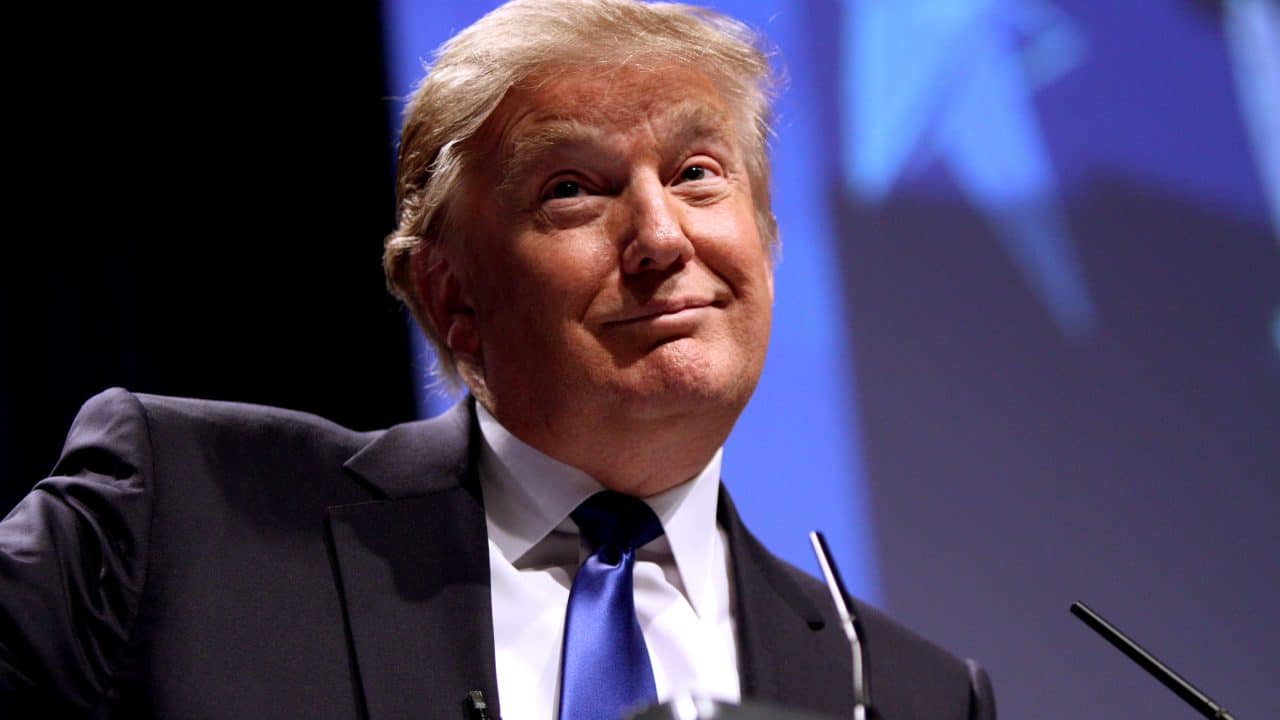
 Donald Trump Speaking by Gage Skidmore is licensed under CC BY-SA 2.0
Americans for Tax Reform led 24 organizations in a letter urging President Trump to take strong action against European tech taxes. These narrowly tailored taxes amount to a systematic campaign against American technology and telecommunications firms.
The letter commends the Administration’s firm response to the European Union’s “digital sovereignty” agenda, which the letter describes as a thinly veiled effort to target the world’s most successful tech companies, nearly all of which are American. It urges President Trump to continue pushing back against these regulatory attacks, which function as non-tariff trade barriers, and to make elimination of discriminatory digital taxes and fees a precondition for any future trade agreements with the EU.
The letter highlights how Europe’s approach insulates its own companies while imposing massive compliance costs, fines, and fees on U.S. firms. It warns that these policies not only harm American innovation and jobs but also risk handing market share to Chinese competitors. The letter also expresses concern over Europe’s efforts to export its regulatory model to Latin America and beyond.
The key points in the letter include detailed criticism of four main EU tools:
● The Digital Networks Act (DNA), including attempts to expand it to cloud services in violation of recent U.S.-EU trade understandings.
● The Digital Markets Act (DMA), which targets so-called “gatekeepers”—almost exclusively American companies—with investigations into firms like Microsoft and Amazon even when thresholds aren’t clearly met.
● The General Data Protection Regulation (GDPR), under which 83% of fines (totaling over $5 billion) have hit American-owned companies.
● Digital Services Taxes (DSTs) imposed by EU member states and others, which could cost U.S. firms up to $117 billion cumulatively over the next decade according to economist Sinclair Davidson.
The letter notes that overall compliance costs and lost revenue from these measures could reach $100 billion annually for U.S. companies, ultimately borne by American workers and consumers through fewer jobs, reduced R&D, and higher prices.
“The EU’s digital regulatory regime imposes compliance costs and lost revenue estimated at up to $100 billion annually on U.S. companies. The consequences ripple far beyond corporate balance sheets. Fewer American jobs are created as companies absorb punishing compliance burdens, while investment in research and development shrinks, slowing the pace of innovation. Those costs do not remain overseas — they are ultimately borne by American workers and consumers. Europe’s regulatory aggression is, in effect, a tax on the American middle class.”
It applauds statements from the Administration, including President Trump’s observation that “the EU makes more from fines on US tech, than tax from ALL of public European tech,” as well as comments from Secretaries Lutnick and Bessent, and warnings from Kevin Hassett about potential consequences for countries maintaining these policies.
“We applaud your clear-eyed response to this challenge. You have rightly pointed out that the “EU makes more from fines on US tech, than tax from ALL of public European tech.”
That message has been reinforced across your Administration. During a recent trip to Brussels, Secretary Lutnick called on the EU to reconsider its digital rules and find “a balanced approach that works with us.” Secretary Bessent has been equally direct, describing the EU’s digital taxes and fines as a centerpiece of trade negotiations and making clear your Administration is pushing back on “tariffs, non-tariff measures, currency manipulation, government subsidies and unfair taxation and fines.” Kevin Hassett has similarly warned that countries maintaining these policies will face “the wrath of U.S. Trade Representative Jamieson Greer.””
Read the full letter here and below:
May 1, 2026
The Honorable Donald J. Trump
President of the United States
1600 Pennsylvania Avenue, N.W.
Washington, D.C. 20500
RE: Coalition in support of ending European attacks on U.S. tech and telecommunications companies
Dear Mr. President:
Europe’s campaign for “digital sovereignty” is nothing more than a euphemism for targeting American businesses. We write to commend your Administration’s strong and principled response to the European Union’s systematic effort to weaponize regulation against the most successful technology companies in the world — which happen to be American — and urge you to continue standing up to these shortsighted attacks on a critical sector of our economy.
The EU and its member states claim their digital laws are designed to promote fairness and healthy competition. The reality is far simpler and far less flattering: these rules disproportionately burden American companies while insulating European competitors from equivalent scrutiny. Europe presents itself as welcoming American innovation and leadership, right up until American firms outperform their domestic champions. At that point, the regulatory apparatus kicks into gear, not to protect consumers, but to kneecap the competition.
Europe has become increasingly candid about this approach. EU policy experts, in response to U.S. engagement, recently claimed that the fact American companies are “feeling the pain” of their enforcement actions means “the laws are actually working” and is, in fact, “evidence” for why “they should be doubling down.” In other words, the pain is the point.
This antagonism extends well beyond economics. It damages the security and strategic cooperation that has anchored the transatlantic relationship for decades. Worse, it opens the door for dangerous, unreliable Chinese competitors to gain ground as American firms are pushed out of European markets by discriminatory fines, fees, and regulatory landmines. The EU’s gain is Beijing’s windfall.
The EU’s Targeted Tactics
The EU’s so-called “digital sovereignty” measures are non-tariff barriers in regulatory clothing — political tools cloaked in complexity to obscure their protectionist intent. They impose asymmetric costs on American firms while extracting billions in revenue from them, with little to no comparable burden placed on European competitors.
While our European friends continue to come up with new and creative tactics, four laws in particular serve as the primary mechanisms for extorting American firms:
The Digital Networks Act (DNA) illustrates how Brussels operates. The European Commission is actively working to extend the law beyond telecoms to encompass cloud services and their infrastructure. A recently leaked draft reveals this expansion as a backdoor mechanism to impose sweeping new network fees targeting American providers. This would constitute a direct and brazen violation of the U.S.-EU trade framework agreed upon last summer, which explicitly affirmed that the EU “will not adopt or maintain network usage fees.” The ink is barely dry on that agreement, and it is already being circumvented.
The Digital Markets Act (DMA) imposes special obligations on so-called “gatekeepers” — the largest, most successful platforms — which are almost exclusively American. Not one designated company is European. In November, the Commission opened investigations into Microsoft and Amazon under the DMA while acknowledging, in its own documents, that neither clearly meets the law’s stated thresholds.
The General Data Protection Regulation (GDPR), while framed as consumer protection, operates as a mechanism for extracting private company data and imposing massive penalties. Eighty-three percent of GDPR fines — totaling more than $5 billion — have been levied against American-owned companies. Eight of the ten largest fines targeted U.S. firms or their subsidiaries. While the rules technically apply to any company operating in the EU, enforcement tells a different story. These penalties function less as consumer protection and more as de facto tariffs on U.S. firms.
Digital Services Taxes (DSTs) complete the picture. Levied by individual EU member states and copycat governments around the world, these taxes are based not on where a company produces value, but on where users happen to click. They fall almost exclusively on large American technology companies, asserting taxing rights with no basis in traditional principles of production or presence.
As economist Sinclair Davidson documents in his study “How Digital Services Taxes Violate Constitutional Principles and Threaten American Commerce,” U.S. firms already pay nearly $3 billion annually in DSTs — a figure that could double by 2030 and reach $9.6 billion under broader adoption, with cumulative costs over the next decade potentially hitting $117 billion. These policies strip revenue from American firms, pass costs on to consumers through higher prices, and divert revenue away from the U.S. Treasury.
Standing Up for American Workers and Consumers
The EU’s digital regulatory regime imposes compliance costs and lost revenue estimated at up to $100 billion annually on U.S. companies. The consequences ripple far beyond corporate balance sheets. Fewer American jobs are created as companies absorb punishing compliance burdens, while investment in research
and development shrinks, slowing the pace of innovation. Those costs do not remain overseas — they are ultimately borne by American workers and consumers. Europe’s regulatory aggression is, in effect, a tax on the American middle class.
We applaud your clear-eyed response to this challenge. You have rightly pointed out that the “EU makes more from fines on US tech, than tax from ALL of public European tech.”
That message has been reinforced across your Administration. During a recent trip to Brussels, Secretary Lutnick called on the EU to reconsider its digital rules and find “a balanced approach that works with us.” Secretary Bessent has been equally direct, describing the EU’s digital taxes and fines as a centerpiece of trade negotiations and making clear your Administration is pushing back on “tariffs, non-tariff measures, currency manipulation, government subsidies and unfair taxation and fines.” Kevin Hassett has similarly warned that countries maintaining these policies will face “the wrath of U.S. Trade Representative Jamieson Greer.”
Stopping the Export of the European Model
But the most recent U.S. efforts to revisit these policies have been met with a blunt response from European officials: the time for discussion has passed, and the U.S. should simply “let go” of trying to change them. That posture violates the most basic principles of fairness and reciprocity that our allies claim to respect. It cannot go unanswered.
More concerning still is the reach of Europe’s approach. European leaders, regulators and industry groups are actively promoting and even directly lobbying for the adoption of their digital rulebook across Latin America. As a result, countries in our own hemisphere have begun adopting similar policies, giving China a foothold in our own backyard.
The EU’s digital framework must not be permitted to become the global standard by default. The window to prevent that outcome is now. As your Administration has rightly argued, eliminating discriminatory digital taxes and regulatory fees must be a precondition for any future trade agreement with the European Union. Anything less risks entrenching these practices and encouraging their expansion. Without a strong response, American innovators will continue to face rising costs and increasingly distorted competition.
We stand ready to support your efforts to defend American workers, American innovation, and the principles of fair and reciprocal trade as you lead our nation into a new era of prosperity.
Sincerely,
Grover Norquist
President
Americans for Tax Reform
Lorenzo Montanari
Executive Director
Property Rights Alliance
James Erwin
Executive Director
Digital Liberty
Ryan Ellis
President
Center for a Free Economy
David Williams
President
Taxpayers Protection Alliance
Phil Kerpen
President
American Commitment
Karen Kerrigan
President & CEO
Small Business & Entrepreneurship Council
Sal Nuzzo
Executive Director
Consumers Defense
Daniel J. Mitchell
President
Center for Freedom and Prosperity
Daniel Erspamer
CEO
Pelican Institute for Public Policy
Kevin Riffe
Chairman
West Virginia Center-Right Coalition
Gerard Scimeca
Chairman
Consumer Action for a Strong Economy
Jessica Melugin
Director of the Center for Technology & Innovation
Competitive Enterprise Institute
Chuck Muth
President
Citizens Outreach
Andrew Langer
President
Institute for Liberty
Bob McClure
President and CEO
James Madison Institute for Public Policy
Tom Giovanetti
President
Institute for Policy Innovation
Jason Isaac
CEO
American Energy Institute
Scott Sturgill
President and CEO
Churchill Strategy Group
Andrew Gins
Director
Shareholder Advocacy Forum
James Taylor
President
The Heartland Institute.
Cameron Sholty
Executive Director
Heartland Impact
Trent England
Executive Director
Save Our States
Benita Dodd Cotton
Chairwoman
Georgia Center-Right Coalition
CC: Secretary Scott Bessent, U.S. Department of the Treasury
Secretary Howard Lutnick, U.S. Department of Commerce
Ambassador Jamieson Greer, U.S. Trade Representative