

 default
The proposal to add another 1% sales tax is a big tax increase on Wichita families.
On March 3, Wichita voters will decide whether to spike the local sales tax rate to 8.75%, a point and a half higher than the California state sales tax. That nearly billion-dollar tax hike will fulfill many progressive dreams: $150 million for failing government “affordable housing” programs, a brand new $75 million performing arts center, and a $225 million renovation of two existing convention centers.
But consultant Michael Austin and other proponents of the initiative are pretending all that new spending will actually save Wichita families money.
They’re lying.
City leaders have had their eye on costly pet projects for years. Since voters would kick them out of office if they raised property taxes again, they’ve come to voters begging for a sales tax increase instead – one that is easier to spread across everyday purchases and harder for taxpayers to see in one place.
Proponents note that 18% of the new tax revenue is earmarked for “property tax relief.” But the ballot measure does not include a spending cap or enforceable limits on future tax hikes. Nothing prevents City Hall from raising property taxes again later, while keeping and spending the new sales tax revenue too.
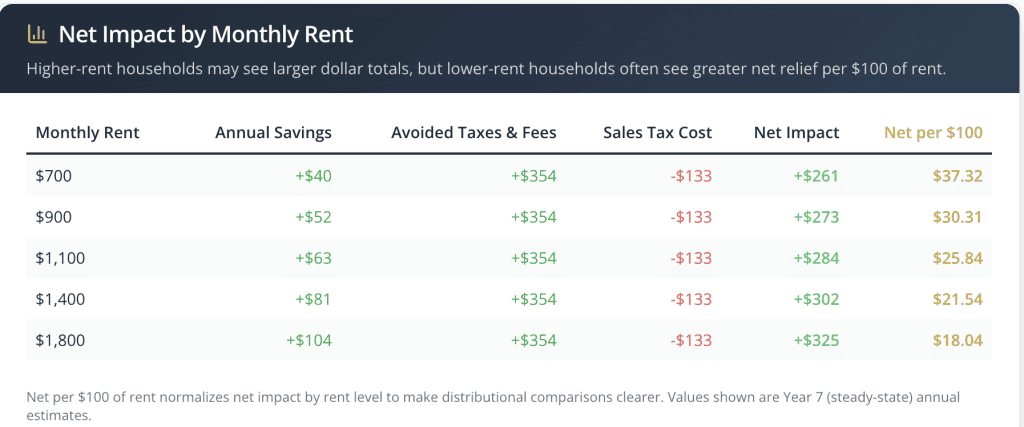
Meanwhile, Mr. Austin offers a model to demonstrate “savings” for taxpayers, available on his consulting website. He claims that “most renters come out ahead.” But his assumptions are flawed, his approach nakedly biased, and his model fundamentally dishonest in its presentation.
For instance, the bulk of his claimed taxpayer “savings” comes from “avoiding future tax increases.” Austin would have you believe that the city council simply has no choice but to raise property taxes to pay for a state-of-the-art public facility and expensive renovations to the facilities they already have. But that is obviously not the case.
Fiscally responsible cities (and state governments) can respond to the outcry over property taxes by controlling spending, scaling back unnecessary projects, and prioritizing truly essential services, like roads and schools. But Austin’s model pretends that tax hikes are inevitable, so jacking up the sales tax instead of even more property tax hikes should count as savings on your tax bill. This approach flies in the face of sound economics and common sense.
Worse, Austin’s “impact calculator” limits users’ ability to measure the sales tax hit. It only allows for adjustment of your monthly rent – but not monthly spending. It assumes a maximum yearly sales tax cost of $133, implying only $13,300 in annual taxable purchases – an implausibly low ceiling. Many Wichitans spend much more than that on goods and services each year. Yet Austin offers no justification for how he reached that number and does not explain why families cannot input their actual spending to estimate their true sales tax burden.
Yes, visitors will pay some share of the new tax. But the vast majority of the revenue will come from Wichita families, already strained by affordability. The city will happily take their money, too, to pay for programs that Wichita does not need.
Despite the “relief” branding, almost every dollar of the new 1% sales tax will fund additional government spending. It will pay for expensive, unnecessary projects. It will be wasted on failing government programs. It will be spent on overpaid, underworked bureaucrats at City Hall. And Wichita families will pay more for basic goods and services as a result.
Instead, the city council could govern responsibly and not raise taxes at all.
Wichita voters: Beware of dishonest rhetoric, misleading calculators, and politicians so addicted to spending they’ll say anything and everything to get you to vote for their latest tax hike.
Don’t let politicians and two-bit economists steal even more of your hard-earned money.