

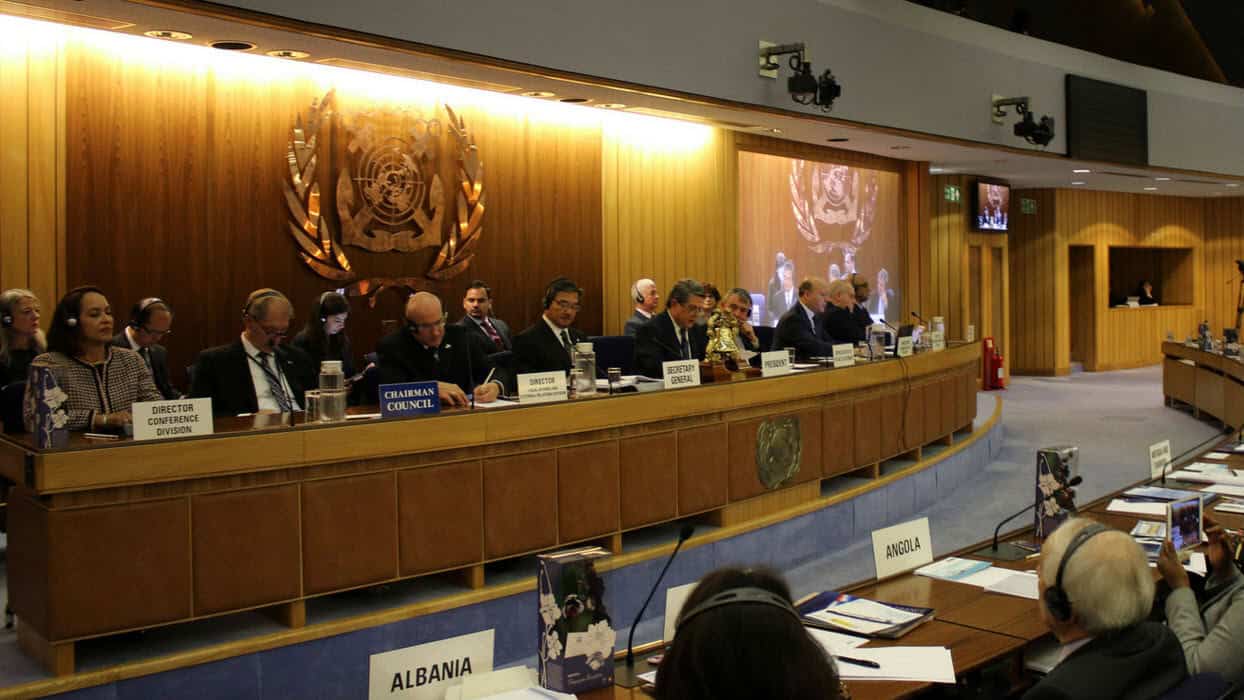
 IMO Meeting is licensed under Creative Commons.
After pressure from the Trump Administration and a majority vote among the members of the International Maritime Organization (IMO), the UN body responsible for setting global shipping standards delayed a key ruling on its “Net-Zero Framework”.
The proposed regulations would set a fee for the emissions of large cargo vessels, aiming to promote reduced fuel intensity and decarbonization in the shipping sector. Unfortunately, this proposal fails to address potential harms to the vital shipping industry, risking significant blowback for consumers.
The IMO’s Net-Zero Framework was originally approved in April 2025, with adoption set to occur last week. After significant international pushback led by the Trump administration, the IMO’s London based adoption meeting ended with its implementation timeline cast into uncertainty, as a motion to delay the vote succeeded in pushing further discussion by one year.
The Net-Zero Framework has been opposed by the Trump Administration due to its potential effects on American consumers. Maritime shipping is an industry of irreplaceable value to the global economy: the maritime industry is estimated to employ roughly 20 million globally while in 2023 alone transporting 41.5% of U.S. trade valued at $2.1 trillion. The global shipping industry’s low costs and large capacity is what enables consumers and producers access to global markets. The IMO’s proposed Net-Zero Framework risks burdening the industry with additional cost, raising prices and impacting consumers.
The significance of price hikes and the complexity of implementation makes the IMO’s carbon tax a major potential disruption to global shipping.
While rates have yet to be finalized, as estimated by the Department of State, a levy of $100 per ton—a lower end proposal—would result in up to a 10% rise in transportation costs. With some calling for rates nearly three times higher at $300 per ton, the potential disruption of this levy is significant, burdening consumers with higher prices.
The complexity of implementation has also raised concerns from the shipping industry. The current leading proposal is for the tax to be levied at the point of sale for fuel. This interpretation would decrease the attractiveness of American ports, incentivizing the use of facilities in weak jurisdictions.
The implementation delay was met with celebration from the Trump Administration with Secretary of State Marco Rubio and U.S. ambassador to the UN Mike Waltz both taking to X following the successful vote to delay to praise the body’s decision.
The IMO’s Net-Zero Framework was poorly thought out to begin with, being too willing to sacrifice consumers for negligible emission benefits. Fortunately, policymakers now have another year to reevaluate the efficacy of the framework and settle on a decision that protects American consumers, American shippers, and American exporters.