
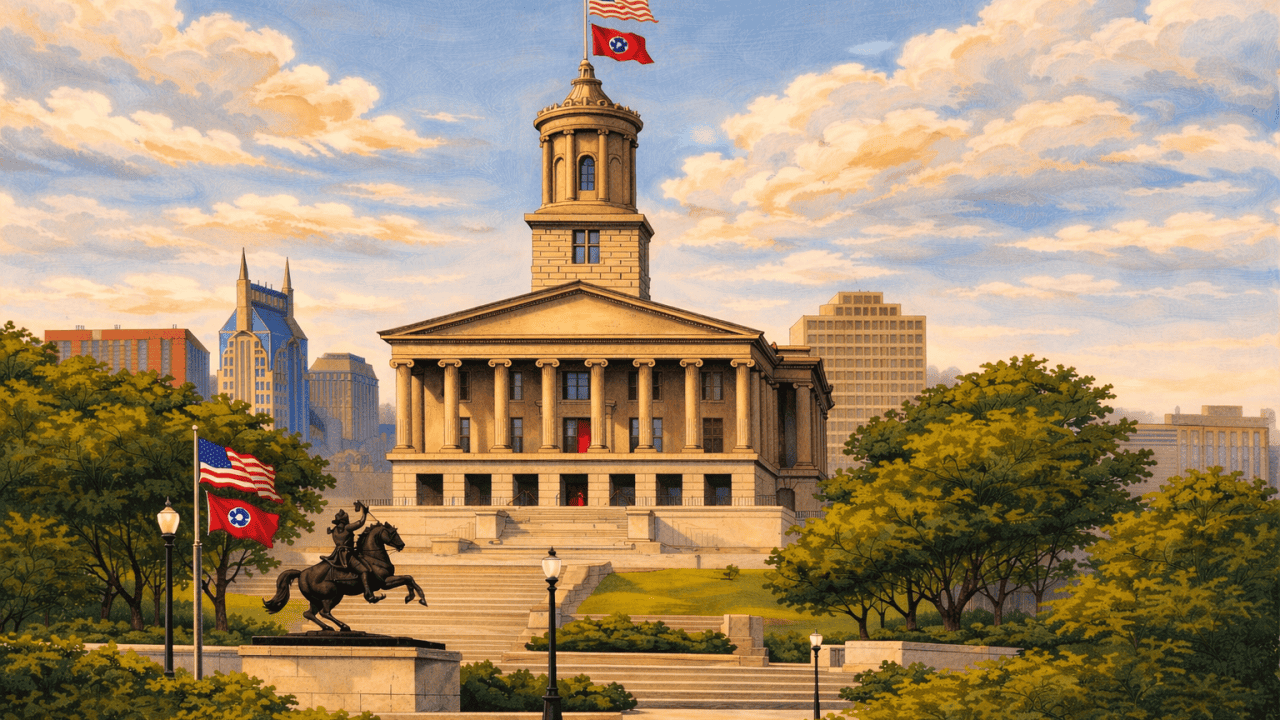
 Tenn Capitol Building
State lawmakers have introduced 1,561 AI-related bills in 45 states as of March 2026, according to Multistate Associates. This flurry of legislative activity, driven lawmakers who want to regulate technology they don’t understand but fear, targets “everything from algorithmic accountability and generative AI regulation to state laws on nonconsensual explicit deepfakes, and the legislative session is still underway,” Multistate added.
With legislators in 45 statehouses busy trying to create a varying legal and regulatory patchwork for AI developers to navigate in the U.S., which underscores why President Donald Trump and many members of Congress wish to federally preempt state regulation of AI. Such federal preemption was included in the initial House-passed version of the One Big Beautiful Bill Act, but the Senate subsequently stripped that provision from the bill before final passage.
Some Republicans in the U.S. Senate wanted to maintain their state’s ability to regulate AI, which they believe would be reasonable. However, by failing to enact federal preemption, Senate Republicans have subjected U.S. AI developers to regulations that many Senate Republicans would not find reasonable, imposed by the likes of Governors Gavin Newsom (D-Calif.), JB Pritzker (D-Illinois), and Kathy Hochul (D-N.Y.).
Yet, as a bill now pending in the Tennessee General Assembly demonstrates, red state legislatures are just as capable of proposing onerous and harmful AI regulations as their blue state counterparts. That legislation, HB 1898/SB 2171, would subject AI developers to a host of new state mandates and regulations.
“It would be surprising to see Tennessee take a more heavy-handed approach to AI regulation than what even Gavin Newsom is comfortable with, but that would be the case if HB 1898/SB 2171 were to pass,” noted a joint letter recently sent to Tennessee legislators by a coalition of conservative and free market organizations. That letter went on to add that “HB 1898/SB 2171 is effectively a Trojan Horse to regulate the entire AI industry under the auspices of ‘child protection.’ However, the mandates that HB 1898/SB2171 imposes on “frontier developers” and “catastrophic risk assessments” go far beyond protection of minors.”
That coalition letter made the case that enactment of HB 1898/SB 2171 would put startups and small businesses at a competitive disadvantage relative to large corporations, “since big businesses already have armies of lawyers and accountants to help them navigate the new regulatory thicket.” The joint letter also warned Tennessee lawmakers that “enactment of HB 1898/SB 2171 could significantly deter investment in Tennessee, chasing capital away to states like Texas, Florida, North Carolina, Georgia, and South Carolina.” Furthermore, the coalition letter added that enactment of HB 1898/SB 2171 “would put Tennessee Republicans at odds with the Trump administration, which has signaled it will not tolerate state laws that use narrow exceptions to implement broad, industry-wide regulations that should be handled at the federal level,”
“The White House’s December 2025 Executive Order created an AI Litigation Task Force in order to strike down state laws that infringe on speech,” the coalition letter reminded legislators, adding that “The Secretary of Commerce is in the process of identifying ‘hostile’ state laws for referral to the Litigation Task Force. Enactment of HB 1898/SB 2171 likely puts Tennessee at the top of that list, with taxpayers on the hook for a losing legal battle with the Trump administration.”
With time running out on the Tennessee General Assembly’s 2026 regular session, many have been worried that Tennessee lawmakers were getting ready to send a proposal to the Governor’s desk that even California lawmakers saw as too heavy-handed. However, the Tennessee Senate decided this week to send SB 2171 back to Commerce and Labor Committee, which should be where this bill goes to die since that committee is not scheduled to meet again this session. However, shortly after SB 2171 was returned to committee, never to be heard from again, the Tennessee House passed its companion bill.
Despite House passage of HB 1898, the bill is likely dead for the year on account of the fact that the Senate just sent its companion back to a committee that is not planning to meet again. However, those lobbying for HB 1898/SB2171 are expected to put on a full court press in the coming days urging the Senate to revive the bill, so a Kalshi bet on the outcome here is still a fairly risky wager.
The aforementioned coalition letter reads as follows:
