

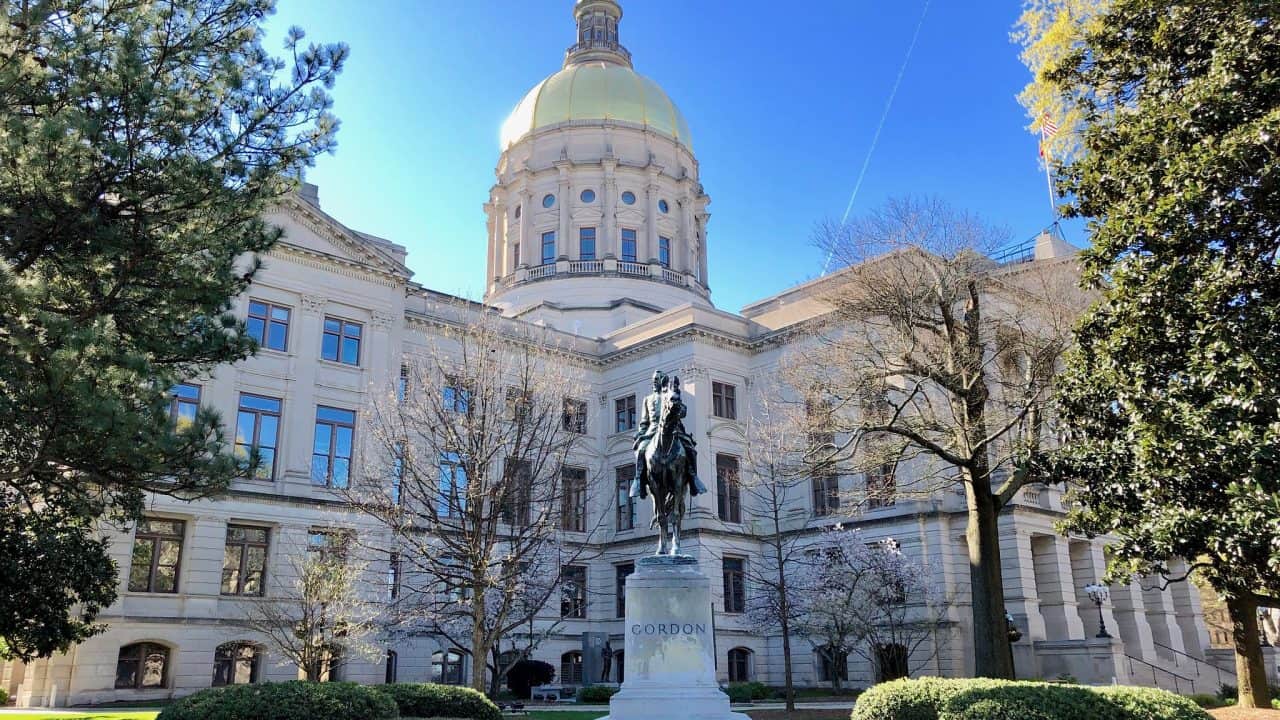
 Georgia State Capitol by Warren LeMay is licensed under CC0
Taxpayer Protection Pledge signer Rick Jackson, a successful businessman from Atlanta, secured the GOP nomination for the Georgia Governor’s race last week after promising to slash income taxes, arguing reform is needed to better compete with neighboring zero-income-tax states of Florida and Tennessee for jobs and surging economic growth.
Jackson’s two primary tax reform objectives are to freeze property taxes to stop runaway assessment increases and eliminate the state income tax. His goal is to cut the state income tax in half within the next four years, while working to fully eliminate it within eight.
Momentum on income tax reform is surging in Georgia. Incumbent Governor Brian Kemp signed HB 463 into law in May, lowering the personal and corporate income tax rate from 5.19% to 4.99%. The bill also provides a pathway for the state’s flat tax rate to drop 0.125% annually, to as low as 3.99%, utilizing revenue triggers to steady the state’s transition out of income tax dependence.
HB 463 is the latest in a yearslong effort to reduce and flatten Georgia’s income tax. Georgia’s top rate is down significantly from 6% in 2018 to 4.99% today, after the legislature adopted a flat tax in 2024 to join the 23 other states with a single-rate tax.
Jackson’s unsuccessful primary challenger, Lieutenant Governor Burt Jones, championed the same mission during his time in office. He established the Senate Special Committee on Eliminating Georgia’s Income Tax, allowing policymakers in the Peach State to examine pathways towards the elimination of the income tax. Working alongside Governor Brian Kemp and Senator Blake Tillery, (GA-19), who chairs both the Senate Special Committee and the Senate Appropriations Committee, Georgia’s elected officials have put Jackson in a prime position to lead the movement to phase Georgia’s income tax to zero if he is elected to serve as Governor.
This work is emblematic of a broader regional trend. Nearby Tennessee and Florida have no income tax. In 2014, North Carolina eliminated their multi-bracket income tax structure in favor of a flat rate of 5.8%, using revenue triggers to incrementally decrease the rate to 3.99% today and 2.99% by 2028. Mississippi followed suit in 2025 and is now on a pathway to complete elimination of their income tax as revenue comes in above a certain threshold. South Carolina, which cut income taxes last year for the first time in state history, is now also using revenue triggers to incrementally reduce their income tax to a flat rate of 1.99% and automatically clicking down to zero thereafter. Just over the Georgia border to the west, Tommy Tuberville and John Wahl, the GOP nominees for the governorship and lieutenant governorship, respectively, have also endorsed eventual elimination of Alabama’s income tax should they win their races in November.
Georgia serves as a regional leader in delivering strong conservative wins and cultivating a flourishing business environment. But lawmakers must not rest on their laurels, else they risk falling behind. Joining the nationwide movement toward income tax elimination is paramount to retaining that position as Tennessee, Florida, and the rest of the South grows and attracts new residents and business investment.
Georgia Republicans should be both excited about the direction of their state’s tax policy and cognizant of the importance of the upcoming gubernatorial election. For nearly three decades, the Governor’s Mansion has retained a Republican resident. Former one-term Atlanta Mayor Keisha Lance Bottoms is determined to change that. If elected, she will derail the positive progress that Georgia conservatives have fought hard to bring to the state. Her mayorship points to her inclination to raise taxes, derail progress and leave her constituency in a worse position than she found them in.
ATR applauds nominee Rick Jackson for signing the Taxpayer Protection Pledge – a written commitment to Georgians to never raise their taxes – and his leadership on taking Georgia’s income tax to zero once and for all, making Georgia a more affordable place to live, work, and raise a family.