

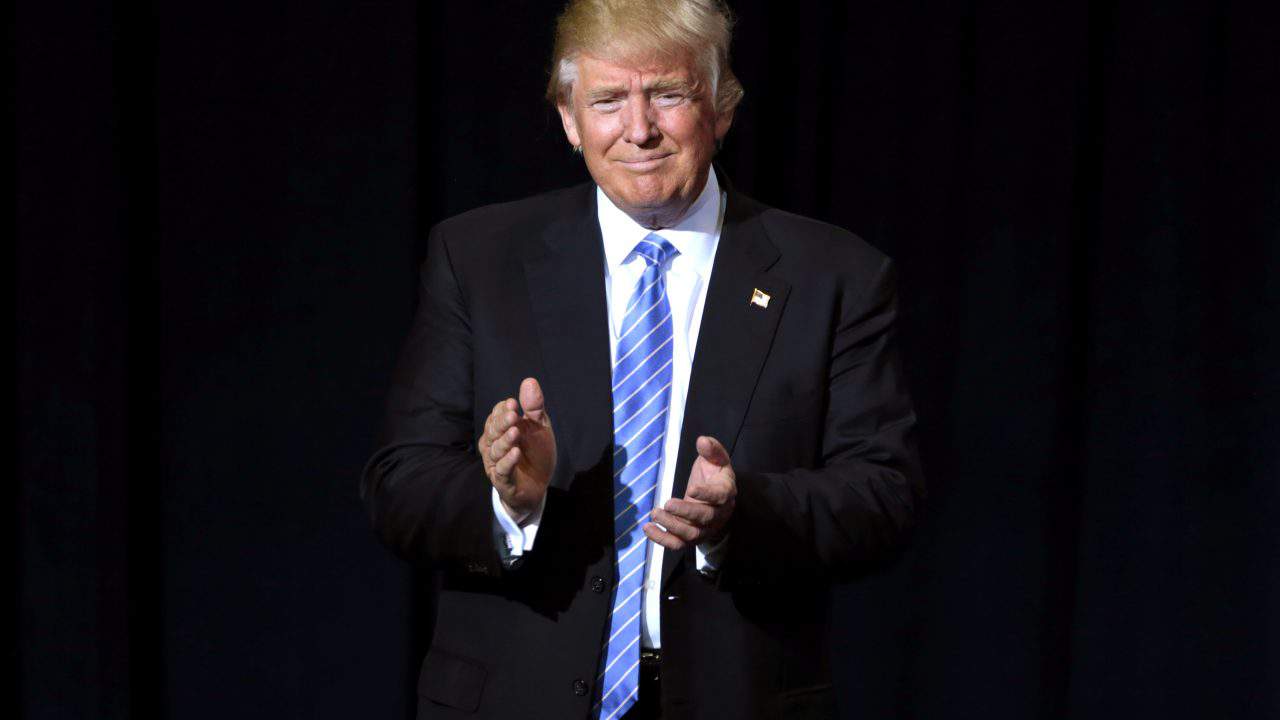
 Donald Trump by Gage Skidmore https://flic.kr/p/LAM6bs
Below are recommended reforms for Congress to pursue in reconciliation that generate revenue for enacting President Trump’s agenda of across the board, pro-growth tax cuts.
Failure from Congress to pass tax cuts would result in the expiration of several of the Tax Cuts and Jobs Act’s (TCJA) provisions – the largest tax increase in American history: the standard deduction (claimed by 90 percent of Americans) would be halved, a family of four earning $80,610 would see a $1,695 tax hike, and more than 26 million small business would be hit with a 43.4 percent tax rate.
Reform Student Loans
The House Committee on Education and Labor recently advanced a slate of reforms to rein in the cost of federal student loans, hold colleges accountable for student outcomes and reduce incentives for colleges to raise tuition.
The Student Success and Taxpayer Savings Plan saves taxpayers over $330 billion to help advance President Trump’s agenda to provide tax relief for American families and small businesses, rein in wasteful spending, and reduce the federal budget deficit.
As the Wall Street Journal notes, The federal student loan balance sheet has ballooned to $1.7 trillion, double what it was 15 years ago when Democrats used ObamaCare to nationalize the industry.
Key elements of reform include:
- Capping the total amount of federal student aid a student can receive annually at the “median cost of college,” compelling high-priced institutions to lower tuition or provide more financial aid.
- New loan limits amending the maximum annual loan limit for unsubsidized loans disbursed to students for an undergraduate program ($50,000), graduate program ($100,000), and professional program ($150,000).
- Terminating the authority to make Grad PLUS loans and subsidized loans for undergraduate students.
- Requiring undergraduate students to exhaust their unsubsidized loans before parents can utilize Parent PLUS to cover their remaining cost of attendance while also establishing an aggregate limit for Parent PLUS loans of $50,000 for parents on behalf of their dependent child.
- Establishing a new standard repayment plan with fixed monthly payments and repayment terms that range from 10 to 25 years based on the amount borrowed.
- Expanding eligibility for Pell Grants to students enrolled in short-term, high-quality, workforce aligned programs to promote more efficient vocational training.
Work Requirements for Able-Bodied Adults on Medicaid
Over a 10-year budget window, implementing work requirements on able-bodied adults under 60 without young children could save taxpayers $260 billion.
Medicaid – a program designed to help pregnant women, the disabled, the elderly, and children – has become overrun with able-bodied, unemployed adults. Today, a plurality of Medicaid spending goes towards able-bodied adults, with 62 percent of them not working, seeking education/training, nor volunteering.
After Obamacare, Medicaid costs have been driven by able-bodied adults, particularly unemployed ones. Democrats, via the Affordable Care Act, expanded Medicaid eligibility to include any adult earning 138 percent of the federal poverty level (FPL) and below. Suddenly, in the 40 states (and DC) who have adopted Medicaid expansion, able-bodied adults of working age were eligible for a program designed to help the neediest among us.
According to the Foundation for Government Accountability (FGA), 69 percent of the increased federal Medicaid costs since 2000 can be attributed to Obamacare enrollment increases. A plurality of Medicaid spending has now been diverted to able-bodied adults, with the breakdown as follows:
- 35.9% of spending on able-bodied adults
- 31.4% of spending on individuals with disabilities
- 19.9% of spending on seniors
- 12.8% of spending on children
Most work requirement proposals simply require able-bodied adults under 60 to be working, volunteering, or training (even part time) to receive Medicaid benefits. While there are several ways to construct these parameters, it is clear something must be done. Right now, the Medicaid program is on an unsustainable track.
Work requirements are popular, will shore up care for those most vulnerable, will subvert out-of-control spending, and will increase labor participation. Lawmakers should seriously consider this reform in their upcoming reconciliation package.
Tort Reform to Address Third-Party Litigation Funding
Tort law is one of the rare cases in which the United States does worse than other nations. Tort law consumes 2.1% of the U.S. economy. The U.S. leads the world in wasteful, unfair and expensive lawsuits.
This situation is worsening thanks to the current practice of third-party litigation funding (TPLF). TPLF allows outside “investors” who are not themselves involved in a legal dispute to target a company or industry and fund lawsuits with the expectation of profiting off any settlement. In recent years, the TPLF industry has exploded to $15.3 billion in annual revenue, making the prosecution of patent infringement lawsuits an immensely profitable profession.
During testimony before the House Subcommittee on Courts, Intellectual Property and the Internet last June, House Republicans expressed surprise after learning that TPLF funders are permitted to remain completely anonymous during legal proceedings, but defendants are required to disclose sensitive information such as internal business records or insurance policy holdings. Americans for Tax Reform has applauded the work of House Republicans in exposing the shadowy network of TPLF legal activism and safeguarding transparency within the US judicial system.
Congress can build upon this great work by reforming the tax code to remove existing incentives for third-party litigation funding.
Under our current tax code, the profits of TPLF funders derived from litigation activities are taxed as capital gains. This stands in contrast to the actual defendants who pay ordinary income tax rates on a taxable award from litigation. Thus, TPLF funders pay a lower tax rate on their portion of a court award than actual plaintiffs while foreign TPLF “investors” can leverage this tax treatment to avoid any U.S. tax obligation from using the U.S. court system to target U.S. companies with lawsuits.
Congress should reform the tax code to remove the comparatively favorable tax treatment of TPLF funders, instead treating their income derived from litigation as ordinary income for tax purposes. By doing so Congress can crack down on the abusive practices of third-party litigation funding while generating revenue to use for pro-growth tax cuts.
Repeal the IRA’s Green New Deal Subsidies
The misnamed Inflation Reduction Act created or expanded several energy subsidy provisions: four clean vehicle credits, residential clean energy credit, energy efficient home credit, clean hydrogen production credit, clean electricity production tax credit, advanced energy project credit, etc.
These green energy credits distort the market, threatening affordability, reliability, and innovation. They also overwhelmingly benefit the wealthy in blue states. Repealing Biden’s disastrous green energy subsidies could pay for a significant portion of President Trump’s agenda and their repeal would restore a freer market in the U.S. energy sector, ensuring more affordability, reliability, and innovation.
When passed, the Congressional Budget Office (CBO) and Joint Committee on Taxation (JCT) estimated that energy-related IRA subsidies would cost about $370 billion over a ten year window. Just two years later, the CBO itself puts the cost at over double its original estimate – $786 billion. The Penn Wharton Budget Model, which initially estimated $384.9 billion over ten years, updated their estimate to $1.05 trillion over ten years for just the climate and energy provisions. As of November 2024, the U.S. Department of the Treasury expenditures report now estimates that the IRA green credits will cost $1.16 trillion from 2025 to 2034.
Because repealing a credit doesn’t necessarily raise what the credit costs, the Tax Foundation estimates that repealing the green new deal credits would raise $851 billion over the 2025 to 2034 budget window.