

 Dollar 100 Dollar Bill Dollar Burning Free Photo by Mediamodifier is licensed under CC.
Income tax rate reduction and elimination has been a top policy trend for more than a decade, but in proposals to reduce or limit property tax burdens have emerged in recent months as an equally important, or in some states a more important fiscal policy priority than income tax relief.
Florida Governor Ron DeSantis recently enacted several property tax reforms in an effort to reduce unnecessary government spending at the local level. “Property tax revenue collected by local governments has nearly doubled in the past seven years and is expected to reach an astounding $83 billion by 2032” DeSantis said in his bill signing remarks: The Legislature passed a major homestead exemption expansion, initially raising it from $50,000 to $150,000, and again to $250,000 if passed by the November 2026 ballot. This is just the first step on the path to eliminate all property taxes in Florida.
In Texas, Gov. Greg Abbott is running for reelection on a platform featuring a multi-pronged property tax relief package that would provide the nation’s strongest safeguard against rising property tax bills. Among the features of Abbott’s property tax relief package is state limit, capping annual increase in all local government spending in Texas to the rate of population growth plus inflation.
There will also be much talk of rising property tax bills on the campaign trail in North Carolina in the coming months. That’s because the NC Property Tax Levy Limit Amendment that will appear on the November ballot would, if approved by voters, authorize a state limit on the growth of property tax collections. Local governments that assess and collect property taxes would have to set property tax rates that ensures collections do not grow in excess of the state-imposed cap.
Meanwhile in neighboring South Carolina, lawmakers have indicated this week that there is interest in pursuing broad property tax relief next year after including targeted property tax cuts for seniors in the new state budget agreement. Senator Tom Davis (R) recently referred to the targeted property tax relief in the new budget agreement as “a down payment to a larger tax cut next year.”
If South Carolina lawmakers decide to make property tax relief a priority in 2027, ATR will be encouraging them to address the root problem driving rising property tax bills, which is overspending on the part of local governments.


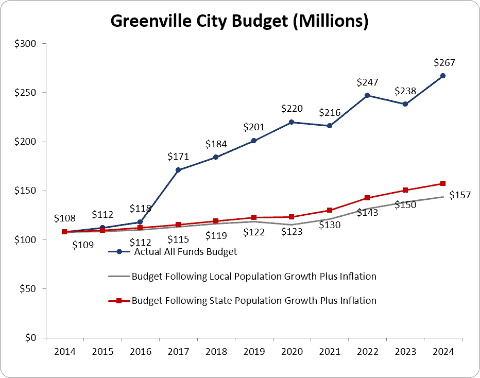
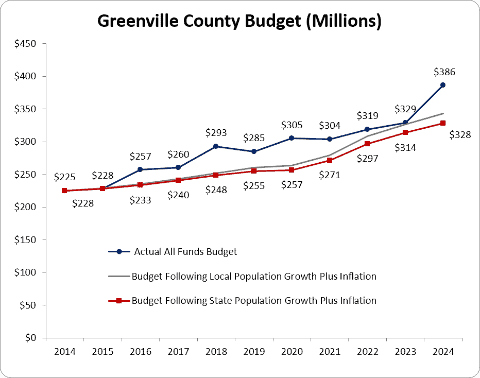
As the above charts illustrate, city and county budgets in South Carolina’s major population centers grew much faster over the past decade than population growth and inflation. The numbers speak for themselves. State legislators can facilitate significant property tax relief in South Carolina and elsewhere by requiring local government to increase spending or property tax collections more modestly.