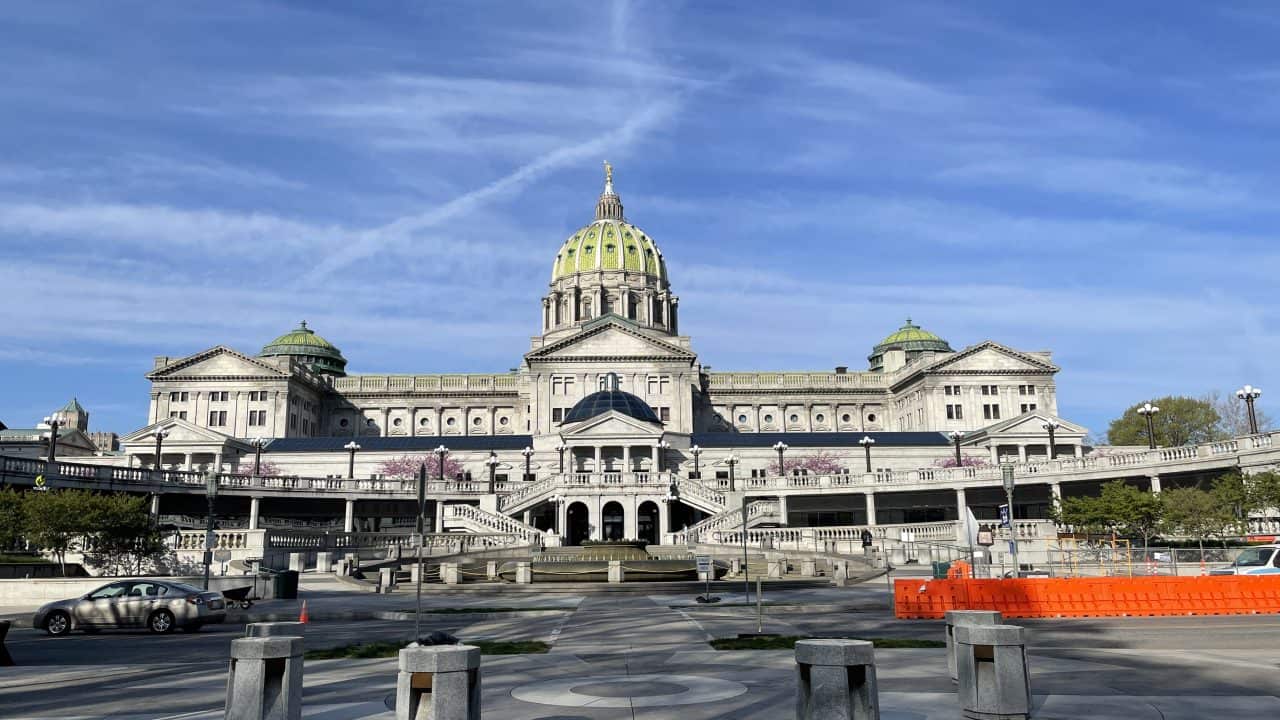
 Pennsylvania State Capitol by Wikimedia Commons is licensed under cc
In a historic—and deeply troubling—move, the Pennsylvania House of Representatives recently voted 139-63 to pass House Bill 1678, marking the state’s first-ever foray into taxing digital advertising.
Passed by the House in a scheme to fund property tax rebates for senior citizens, the legislation is misguided and economically damaging. While the promise of relief for seniors over 65 sounds noble, the mechanism chosen to fund it reveals a fundamental misunderstanding of how modern commerce works.
To understand why this policy is so flawed, look at what it actually expands: Pennsylvania’s long-standing Gross Receipts Tax (GRT). Unlike a standard corporate income tax, which is levied on a company’s net profits after expenses, the GRT is a 5% tax applied directly to total revenue before a single expense is deducted. Historically, this tax has been reserved for utilities and telecommunications companies. HB 1678 expands this tax code to include revenue generated from digital advertising services.
Proponents argue that this will pull between $329 million and $500 million annually from out-of-state Silicon Valley corporations to pay for local senior rebates. To sweeten the deal politically, the bill even exempts local broadcast stations and traditional news media.
But this “Big Tech pays their fair share” narrative completely ignores basic economics.
Multi-billion-dollar platforms do not simply absorb a 5% tax on their gross revenues. Instead, those costs are passed directly down the line to the consumer. In the modern economy, the primary consumers of localized digital advertising are not other massive corporations—they are Pennsylvania’s small businesses. Main Street retailers, local restaurants, and independent contractors rely on hyper-targeted Facebook and Google ads to find customers and grow.
By raising the cost of digital advertising, the state is effectively placing a hidden tax on its own economic engine. The risk of stifling small business growth and driving commercial interest out of the Keystone State far outweighs the short-term benefit of a targeted rebate program.
Conservatives should not be surprised by this bait-and-switch. This is classic partisan redistribution: rather than addressing the state’s actual spending habits or implementing meaningful structural tax cuts, the government simply siphons money from a group they deem “justified” to penalize, using a sweet-sounding tax break for seniors to soften the blow. The Democrats did not even include necessary details, such as income limits for rebate eligibility, mechanisms for estimating how much advertisement revenue is actually attributed to Pennsylvanians exclusively, and provisional measures for the potential situation of claims exceeding revenue availability. The lack of specificity here shows where the real focus of the policy lies. It is all about taking, not giving.
It does not have to be this way. Pennsylvania is well-positioned to live within its means. If state legislators tackled the underlying spending problem and pushed for meaningful reductions in social welfare programs, the state could extend property tax relief to all citizens, not just a selective demographic bankrolled by a hidden tax on small businesses.
The digital advertising tax is not a victory for affordability. It is a dangerous expansion of an aggressive tax structure that will ultimately leave Pennsylvania small businesses footing the bill.
