

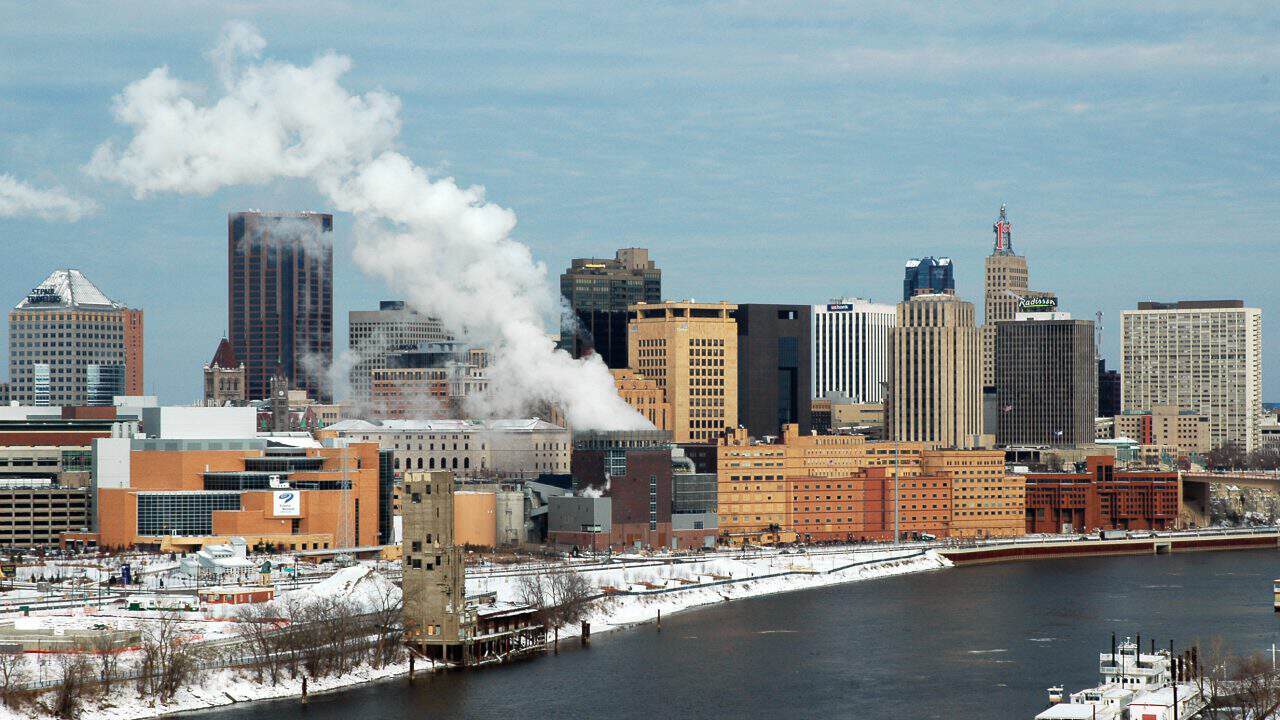
 Panorama of the city of Saint Paul, Minnesota by John Polo is licensed under CC BY-SA 3.0
It is no surprise that housing affordability has become a major concern for Americans. A new report from the Minneapolis Federal Reserve shows that one of the progressive left’s favorite proposed solutions to the housing crisis, rent control measures, has disastrous effects.
According to the Harvard University Joint Center for Housing Studies, 24% of all homeowners and 49% of all renters are considered cost-burdened households, meaning they spend more than 30% of their income on housing costs. As a result, politicians across the political spectrum and the 50 states have proposed various measures to address the problem and reduce housing costs for Americans.
The rising cost of housing stems from government constraints on building, meaning that if the government got out of the way and cut red tape, prices would come down.
On the other hand, some have blamed rising housing costs on greedy developers who are exploiting everyday Americans. The solution, according to them, is to institute rent control and stabilization policies.
This thinking is immediately disproven when considering the twin cities that have taken different approaches to the rising cost of housing. In 2018, Minneapolis launched the Minneapolis 2040 Plan, focusing on eliminating single-family zoning, allowing accessory dwelling units on owner- and non-owner-occupied properties, and expanding inclusionary housing policies to support mixed-income housing production.
By contrast, in 2021, St. Paul voters approved a rent stabilization ordinance, which limits residential rent increases to no more than 3% in a 12-month period. Immediately, though, the city had to amend the policy to prevent this ordinance from applying to new housing construction, and in 2025, it was expanded to exempt all buildings built after 2004 from this policy.
Given similar geographies and demographic makeup, the two approaches simulate a near-perfect experiment between a city that has chosen to deregulate and one that has chosen to regulate.
Multifamily housing production has felt a chill
According to new research from the Federal Reserve Bank of Minneapolis, prior to the 2021 rent stabilization policy, St. Paul was building out multifamily housing. In 2020 and 2021, the city permitted more than 2,000 new housing units, the most since 1970. However, in 2024, only 404 building permits were issued, with another decline happening in 2025.
This is especially startling when compared to the 3,019 new building permits issued by Minneapolis in 2022
For developers of this multifamily housing, the drop is attributable to a lack of capital entering the city. This makes sense. Investors will not invest in a project if they do not expect to make a profit.
Operating Costs are up while rent revenues remain flat, a metro-wide trend
Under the St. Paul ordinance, landlords may raise rents by only 3% each year. This was loosened in 2022, allowing owners to raise rents beyond 3% if they could justify it to the rent control board. They can also raise rents beyond 3% if they have a “just cause” vacancy, meaning that the owner did not force the renter out of the unit.
What this has led to is underreporting. In 2024, approximately 18,000 renting households moved out of their units, while only 900 were documented. Rather than gambling with the rent control board on raising rents beyond the 3% cap, owners were derisking and only taking the allotted increase.
This has put owners in a bind. They can only increase rents by a specific amount but have to deal with property taxes and other costs that are rising faster than 3%. This leads to properties deteriorating in quality and condition, with very little incentive to make the necessary repairs. This hurts both owners, who are going to have a harder time selling the unit, and renters who are stuck living in worsening conditions.
Property Values have been Sinking
St. Paul has brewed a dangerous cocktail of minimal rent increases, higher taxes, and deteriorating property quality. All of this has led to property values sinking hard. According to the report, in 2020, the median price of an apartment unit in St. Paul was $160,525. In 2025, it had fallen to $103,249. With the falling price coupled with a high-interest-rate environment, owners cannot refinance and are stuck with aging properties.
With falling property values, the property tax base in St. Paul has been declining. From 2022 to 2025, owners of multifamily apartment buildings have paid 27% less in property taxes, while the median annual property tax has fallen from $2,825 in 2020 to $1,958 in 2025. As the tax base shrinks, current owners are now more concerned about having to pay a larger share of the property tax levy.
The impact of this soon becomes cyclical. High property taxes cause owners to leave the market, putting additional pressure on existing owners and further squeezing them out. This is a hard death spiral to break out of and will only lead to St. Paul being unable to provide basic upkeep for city infrastructure.
Conclusion
It is understandable why many progressive politicians have been so quick to jump on the rent control bandwagon. It frames the affordability crisis with a clear villain, a sympathetic group, and a silver bullet that would solve the issue.
However, St. Paul proves the disastrous second-order impacts of rent stabilization policies. The lack of rent increases makes it harder to do business in the city, leading to less capital entering the market, owners getting pushed out, and properties that will continue to worsen as time goes on.
This did not have to be the current state of St. Paul. As mentioned in the report, there was a lot of energy and optimism in St. Paul’s housing market, some of which remains. It just needs to be harnessed and set free. Rather than following the disastrous rent stabilization policies of St. Paul, cities and municipalities should look to its twin city, Minneapolis, as a model for solving the affordability crisis. By expanding the housing supply in the city and encouraging development, Minneapolis has been experiencing rent declines and increasing property values.