
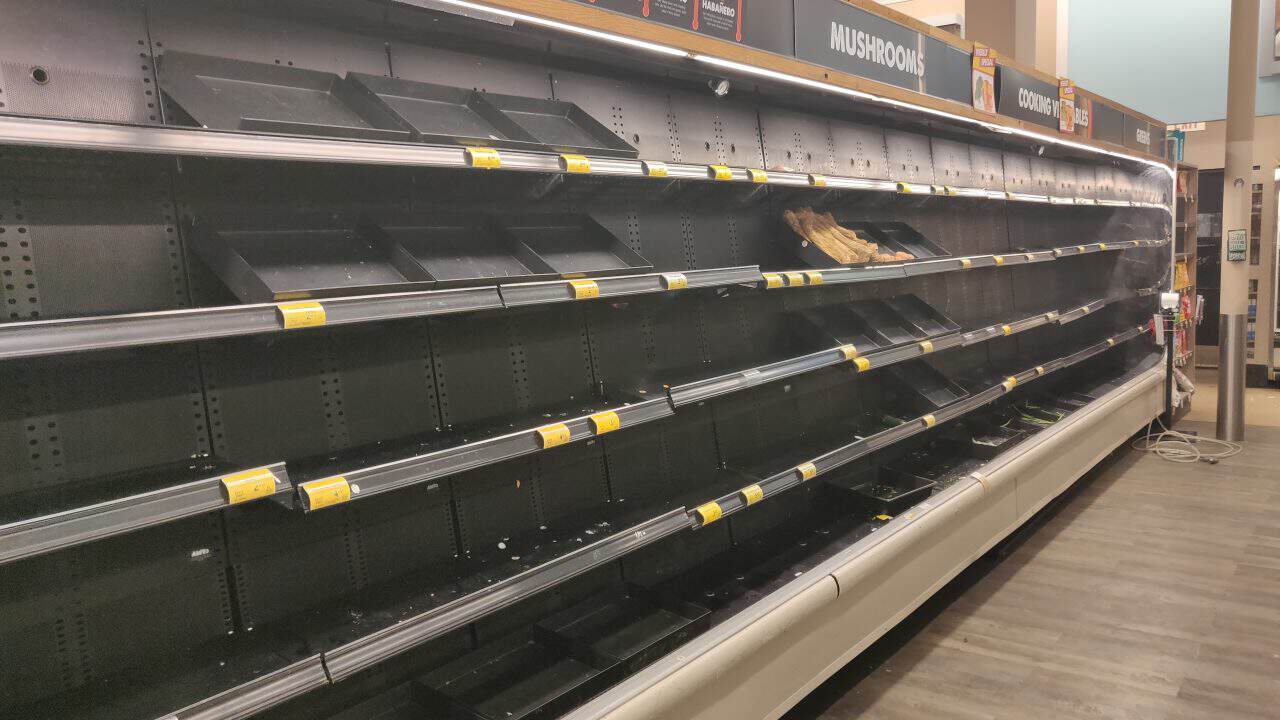
 empty vegetable shelf by Kurt Kaiser is licensed under Creative Commons CC0 1.0 Universal Public Domain Dedication.
A Zohran breadline will be coming to a borough near you. After receiving a bailout from the Governor of New York, Kathy Hochul, the Mayor of New York City, Zohran Mamdani, announced preliminary plans for his 5-borough, government-run grocery stores, intended to solve every societal ailment by lowering grocery costs, creating high-paying jobs, and supporting the small-business community. While commendable, these government-run grocery stores will just be another government boondoggle that wastes taxpayer money without solving the underlying issues.
The economics behind this plan do not add up. Mamdani pledged that these grocery stores will offer a 30% discount on a core basket of goods, such as meat, seafood, and produce, calculated based on fair market rates. According to Mamdani, eliminating the profit incentive can reduce costs. But this line of thinking does not work with the reality of the business ecosystem. Grocery stores already run on razor-thin profit margins, ranging from 1% to 3%. Even excluding the profit motive does not fully address the 30% discount that Mamdani is proposing and does not include other parts of the proposal, such as high-quality jobs with best-in-class wages.
To get the discount, it would have to come in the form of taxpayer subsidies, which would only grow over time. The start-up costs are already ballooning out of control, as New York City has already allocated a whopping $70 million to build these stores. Furthermore, because of artificially low prices, these government-run grocery stores will experience high demand, leading to empty shelves. Those empty shelves will only intensify pressure to increase subsidies and raise these stores’ costs, further pressuring the city government to push for increased taxes. This is more likely to occur since these grocery stores do not have any limits on how many products can be purchased or any means testing for who can shop there, thus making comparisons to programs like military commissaries and food stamps moot.
These conditions only spell danger for the local bodegas and privately-run grocery stores that are already operating. Even though Mayor Mamdani claims this plan will not hurt these local businesses because they will not sell hot foods or cigarettes, it is still taking out a key part of their business. If these government-run grocery stores are going to provide kitchen essentials at steep discounts, there is very little incentive to shop at a private grocery store. Even if stores are run more inefficiently, people have shown a willingness to tolerate this if the trade-off is access to cheaper goods.
What this will look like is private bodegas and grocery stores closing their doors. As mentioned before, staple goods like milk, eggs, and meat will be sold below market rate, meaning there is no possibility for private stores to effectively compete on price with the government-run grocery store. Furthermore, the government-run store can continue to subsidize its losses in a way that the private store simply cannot, forcing it out of business. This is incredibly damaging for multiple reasons. These small businesses are better able to recognize community needs than a government bureaucrat in City Hall, since they deal with them daily. It shows when they hire people who may not have opportunities in big-box retail stores, and can treat employees better. Thus, it is no wonder that these mom-and-pop stores are suing the city for setting up an anti-competitive structure.
There is good reason to be concerned about government-run grocery stores, as real-world examples show these schemes rarely work out. In the Soviet Union, meddling by government bureaucrats led to constant food shortages. When Boris Yeltsin, the first President of Russia, saw an American supermarket, he commented that if the Russians could see the conditions in their geopolitical adversary, “there would be a revolution.” Looking closer to home, prior government-run grocery store initiatives have failed. In Caney City, Texas, the city council voted to sell its government-run grocery store, Caney Grocery, to a private company after the government racked up a massive $750,000 debt. A similar story happened in Baldwin, Florida, where the government-run grocery store had to shut down after running in the red from 2019 to 2022.
What makes this situation frustrating is that Mayor Mamdani and the city government know the actual answer to reducing grocery prices. In the initial report, the New York City Economic Development Corporation stated that it would work to reduce regulatory burdens and streamline permitting. Mayor Mamdani has also voiced his support for this when he announced “OPEN for Small Business”, a regulatory reform that would make it easier to do business in the city, as well as releasing the preliminary Commission on Government Efficiency report, highlighting the need to streamline outdoor dining permits. What is clear is that Mayor Mamdani and the city government know what to do to make New York City more affordable for consumers and businesses; they would rather burn taxpayer money along the way. What a shame.