

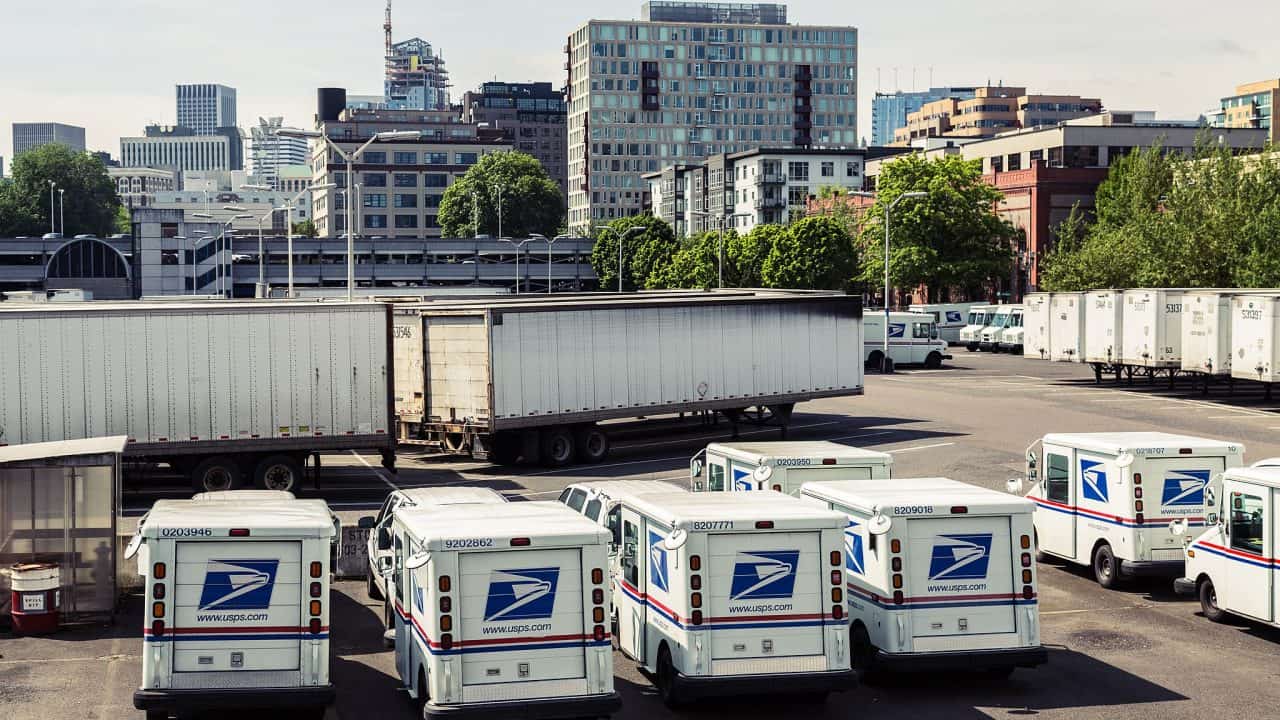
 Portland Main Post Office - USPS Trucks is licensed under CC BY-SA 2.0
Americans for Tax Reform President Grover Norquist on Friday sent a letter to U.S. Postmaster General David Steiner with recommendations for improving the dire financial state of the United States Postal Service (USPS).
The USPS is reportedly set to announce losses of more than $9 billion for the second fiscal year in a row. Without significant reforms, the USPS is headed toward insolvency. ATR suggested reforms to get the USPS back on a path toward financial stability, focusing on freezing non-essential capital expenditures, cutting labor costs, and making better use of the more efficient private sector.
Read the full letter here or below:
November 7, 2025
The Honorable David Steiner
Postmaster General
United States Postal Service
475 L’Enfant Plaza SW
Washington, DC 20260
Dear Postmaster General Steiner,
I would like to extend my congratulations to you for being named the Postmaster General earlier this year. As the United States Postal Service’s (USPS) Board of Governors meeting approaches, Americans for Tax Reform has several suggestions for key reforms to improve the financial state of the USPS, focusing on freezing non-essential capital expenditures, cutting labor costs, and making better use of the more efficient private sector.
The USPS is currently in a precarious financial situation.
Under the “Delivering for America” plan imposed by former Postmaster General Louis DeJoy, the USPS has been losing billions of dollars per year and mail service has plummeted. While the Delivering for America plan originally projected that USPS would have already broken even by Fiscal Year 2023, the USPS more recently projected a $6.9 billion loss for FY 2025.[1] Now, USPS is expected to report a loss of more than $9 billion for FY 2025, the second year in a row with losses above $9 billion.[2] Without significant reforms, USPS is on a dangerous path toward insolvency.
USPS should freeze non-essential capital expenditures and maximize use of the private sector.
The Postal Service’s proposal to invest $40 billion in building middle-mile mail and package processing facilities unnecessarily duplicates infrastructure that already exists in the private sector. Private companies can handle these operations more efficiently, reliably, and at lower cost, with significantly higher on-time delivery rates than the USPS has achieved when managing the process internally.
The private sector is especially well-suited to manage the processing and transportation of mail and packages near their destination before USPS completes final-mile delivery. USPS should re-focus on the core mission of final-mile delivery and leverage the innovative nature of private-sector partnerships to better allocate its manpower and financial resources.
Moreover, the Postal Service should avoid using limited funds on politically driven and financially unsustainable projects, such as purchasing electric mail vehicles or expanding into ancillary services like postal banking. Over the next decade, halting these wasteful expenditures and increasing private sector participation could save tens of billions of dollars.
USPS should also freeze full-time, career, non-carrier hiring and reduce the permanent workforce through attrition.
Approximately 80 percent of the Postal Service’s expenses come from labor. In an effort to appease union leadership, former Postmaster General DeJoy exacerbated this issue by initiating what he called “the biggest insourcing ever in America.”[3] He converted 190,000 flexible, part-time employees into permanent career positions, raising short-run wage and benefit costs while also increasing long-run unfunded pension and retiree health liabilities.[4] These actions further strained an already unsustainable financial structure.
Going forward, the Postal Service should restrict new full-time career hires to roles directly involved in its core mission of final-mile delivery. Given the continued decline in mail volume, USPS should also work to reduce its overall career workforce. Such labor cost reforms could save the agency billions of dollars.
Combined, these reforms would provide significant financial savings for the USPS while improving the quality of service for Americans.
Onward,
Grover Norquist,
President, Americans for Tax Reform
Cc:
Majority Leader John Thune
Speaker of the House Mike Johnson
Chairman Rand Paul
Chairman James Comer
Mr. Vince Haley
Mr. Russ Vought
Mr. Dan Bishop
Mr. Eric Ueland
Mrs. Susie Wiles
Secretary Scott Bessent
[1] https://www.govexec.com/management/2024/11/usps-loses-95b-fy24-and-says-another-red-year-coming/401077/
[2] https://www.cagw.org/the-uspss-frightening-fiscal-failures/
[3] https://atr.org/no-ode-to-dejoy-trump-turncoat-pushed-out-as-postmaster-general/
[4] https://federalnewsnetwork.com/agency-oversight/2024/12/doge-supporting-lawmakers-call-on-usps-to-privatize-some-operations-rein-in-electric-fleet/