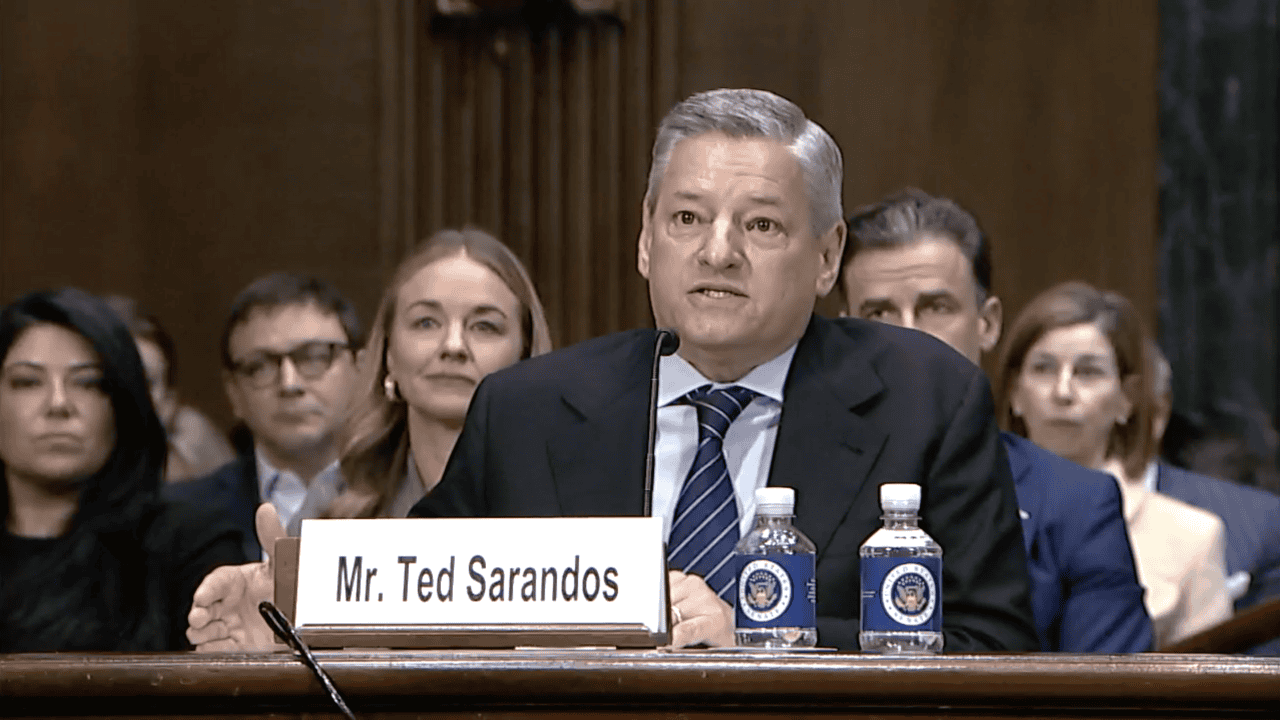
The Senate Judiciary Committee’s Antitrust Subcommittee held a hearing on Tuesday to examine a proposed acquisition of Warner Bros. by Netflix, Inc. The hearing, chaired by Senator Mike Lee (R-Utah), featured Netflix Co-CEO Ted Sarandos and Warner Bros. Discovery Chief Revenue and Strategy Officer Bruce Campbell as witnesses.
Netflix announced an agreement on December 5, 2025, under which it would acquire Warner Bros., including properties such as HBO and HBO Max. The transaction is expected to close in 12-18 months, according to Netflix, pending approvals by shareholders and regulators.
In the meantime, members of the Senate had key exchanges with the executives on Tuesday in their oversight capacity.
Commitment to U.S. Job Growth
In one exchange with Senator Josh Hawley (R-Mo.), Netflix Co-CEO Sarandos said it is “in our business plan” and “in our long-term operating DNA” to increase domestic U.S. production and domestic U.S. production jobs.
Sarandos noted that already to date, Netflix has “created more than 155,000 American jobs and contributed $225 billion to the U.S. economy.” The combined company, if approved, would continue to increase this domestic production within the U.S. and the jobs that fuel it.
“Juggling Multiple Subscriptions”
In his opening statement, Senator Chuck Grassley (R-Iowa) highlighted a common problem faced by his constituents:
“Families in my state of Iowa and across the country already juggle multiple subscriptions, and they deserve real competition that keeps prices in check.”
As more companies have developed more streaming services in recent years, a growing number of consumers have expressed frustration over the need to purchase and keep track of so many different subscriptions to watch their favorite shows. This is a market ripe for greater consolidation, as consumers have indicated.
Significant Overlap in Subscriber Base
In his opening statement, Sarandos explained that there already exists a large amount of overlap between the subscriber bases of Netflix and HBO Max, which is owned by Warner Bros.
“In fact, 80 percent of HBO Max subscribers also subscribe to Netflix. We will give consumers more content for less.”
In an exchange with Senator Adam Schiff (D-Calif.), Bruce Campbell confirmed the same statistic: “80% of the HBO Max subscribers today already get Netflix. Now, with this transaction, Netflix will have the opportunity to offer those two services together at a discount.”
This acquisition would provide significant value for current subscribers. The economies of scale created by the acquisition would allow consumers to face lower prices with an expanded media library. For the vast majority of current HBO Max subscribers, they would be able to shrink their dual subscriptions into a single subscription at a price lower than they are paying for two services.
Little Change in Market Share
Sarandos explained that the acquisition of Warner Bros. would actually represent a very small increase in the TV market share controlled by Netflix:
“Netflix, with all of our success, are only about 9 percent of TV viewing time in the U.S. With Warner Brothers, we’ll be about 10 percent.”
The video streaming market faces steep competition. Not only are the countless TV and film streaming platforms competing with each other, but they are also competing for watch time against traditional TV and film studios as well as video content creators on social media platforms. The majority of young adult viewers now spend more time viewing social media content than streaming content, demonstrating the high level of competition for watch time among consumers.
Democrats Abandoning Traditional Antitrust Law
Under the consumer welfare standard, the interests of consumers are put first, as the government asks whether a certain market action or condition will realistically harm consumers by introducing higher prices or worse quality. This has been a longstanding guiding principle of U.S. antitrust law, which previously had strong bipartisan support.
Today, Democrats have attempted to uproot this principle. The Biden administration’s Department of Justice (DOJ) and Federal Trade Commission (FTC) strayed far from the consumer welfare standard, instead adopting a philosophy of “big is bad” when it comes to the size of companies.
In exchanges with the witnesses at Tuesday’s hearing, Senator Amy Klobuchar (D-Minn.) Klobuchar touted the overbearing antitrust bills she has proposed, such as the Competition Antitrust Law Enforcement Reform Act (CALERA). These proposals seek to move U.S. policy away from the consumer welfare standard and toward overregulation instead.
When evaluating the proposed acquisition of Warner Bros., regulators should keep the needs of consumers in mind. The “big is bad” philosophy of the previous administration must be rejected, instead returning to the free-market approach that has allowed the United States to prosper.