

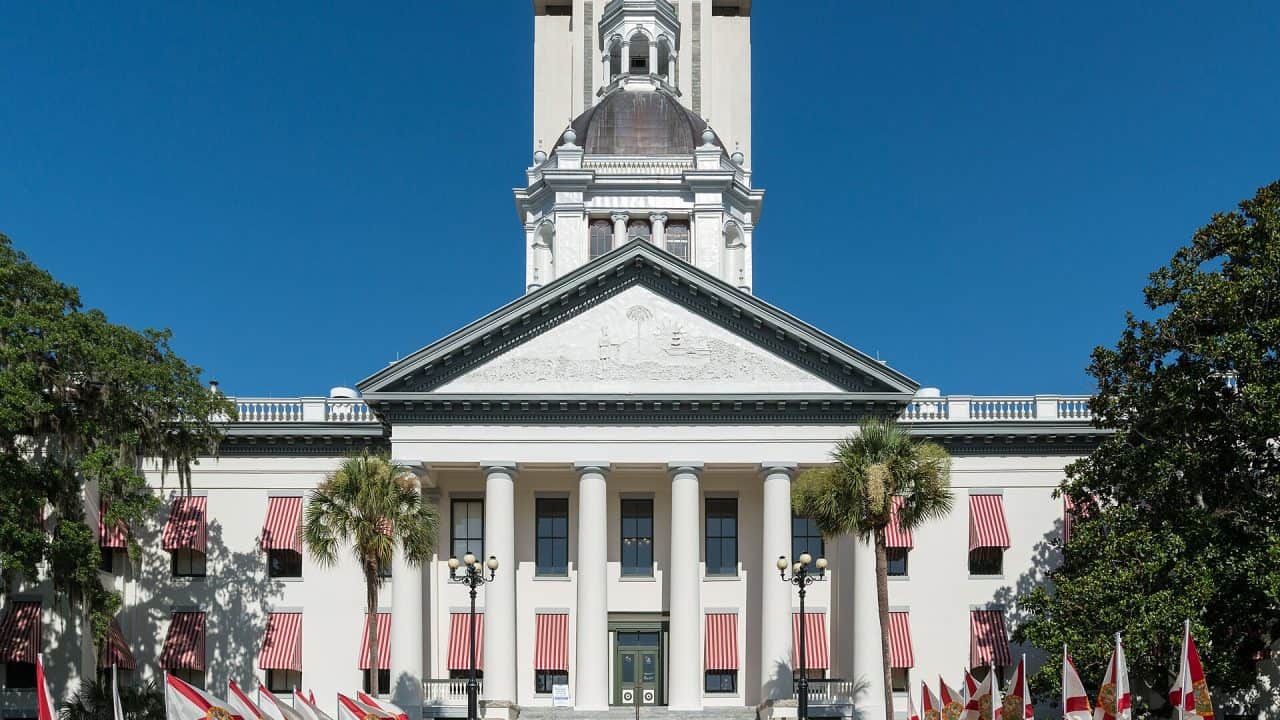
 Florida State Capitol by DXR is licensed under Creative Commons License 4.0
The Sunshine State is continuing its leadership on protecting citizens from attempts to impose radical left-wing policy. This session, lawmakers have passed innovative legislation to stop all levels of government in the state from enacting pie-in-the-sky “net-zero” policies that drive up energy costs.
The Florida Senate passed House Bill 1217 on March 11th. It was co-sponsored by Representatives Berny Jacques, John Snyder, and Chase Tramont. It is expected to be signed into law by Governor Ron DeSantis and will take effect on July 1.
The law would ban the adoption and enforcement of “net-zero” policies, including fees to fund such policies, by governmental entities, including any level of government within the state, as well as public schools and higher education.
Net-zero means reaching a balance where the total amount of greenhouse gases emitted into the atmosphere equals the total amount removed from it — so the net addition to the atmosphere is zero.
Under this bill, governmental entities may not use public funds to provide purchasing preferences for any goods, such as vehicles, equipment, and appliances, based on the sources of fuel used by or in the production of the goods. Public funds could not be paid to nongovernmental entities that adopt or advocate for net-zero policies, nor could the government join such organizations.
Every year, all governmental entities would be required to submit an affidavit to the Florida Department of Revenue, attesting to compliance with the bill.
Governmental entities also may not impose fees or penalties to advance net-zero, such as charges based on carbon content of a fuel, the greenhouse gas emissions of a product or activity, and charges connected to a carbon trading system.
Because the effectiveness of carbon capture technology is somewhat dubious, pledges to reach net-zero by year “X” often force the government to drive up the price of energy to reduce greenhouse gas emissions. Banning cap-and-trade schemes therefore ensures that Florida never makes the same mistake as other states by joining unaccountable interstate bureaucracies like the Regional Greenhouse Gas Initiative (RGGI). RGGI effectively imposed an energy-tax on the citizens of nearly a dozen states in the Northeast that caused their electricity prices to rise 64% more than in non-RGGI states.
Another example of the net-zero madness can be seen in New York City, where the passage of Local Law 97 in 2019 required buildings to drastically reduce greenhouse gas emissions according to a strict timeline. Failure to comply resulted in a $268 fine per metric ton of excess carbon annually, which manifested in higher rents and large maintenance fees for tenants of multi-unit housing complexes. with the backlash culminating in a lawsuit against the city.
At a time of rising gas prices and general cost of living, as well as attempts from radical climate activists to push their policies on any level of government possible, this legislation is critical. Florida continues to lead in protecting its residents from costly, damaging government misadventures.