

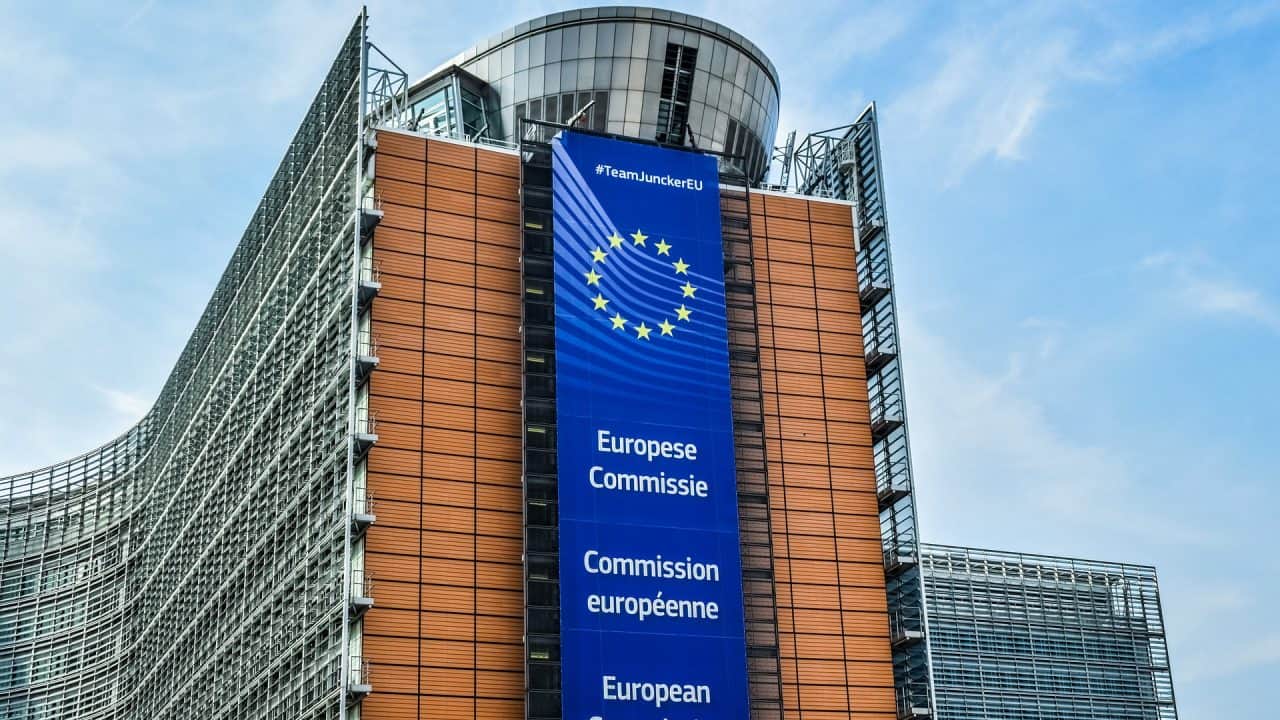
 European Commission is licensed under Creative Commons.
President Trump is right; the United States should not tolerate digital trade barriers designed to impose record fines on American businesses.
After a series of posts on identifying billions of dollars in fines by the EU on American companies Trump declared “I will be forced to start a Section 301 proceeding to nullify the unfair penalties being charged to these Taxpaying American Companies. Thank you for your attention to this matter!” (Truth).
301 Investigations are a conventional tool available to the President to remedy “unjustifiable” and unfair trade practices. The digital and AI economy is a significant part of America’s comparative advantage and must be defended, the Biden administration ignored these threats allowing these regulations to fester and spread.
In his Truth posting Trump notes recent fines of $3.5 billion for Google and $17 billion imposed on Apple, for violating supposed anti-competitive practices, breaching Digital Markets Act rules, and European tax rules.
These fines are the latest that stem from a long list of digital regulations that hit American companies almost exclusively and rather than achieving increased competition, fairness, or other stated aims- they result in enormous fines.
In fact, an industry study finds they will cost American firms $97 billion annually, $62 billion in fines alone. This would make American tech firms the largest contributor to the EU budget which is usually Germany at $33 billion.
The 2025 National Trade Estimate identified digital trade barriers imposed by the European Commission including Digital Service Taxes (DSTs), Digital Service Act (DSA), Digital Markets Act (DMA), AI Act, Data Act, data Localization rules stemming from General Data Protection Regulations (GDPR), and even Network Usage Fees.
The 2025 Trade Barrier Index found the European Union led over China, India, and Vietnam for imposing more digital trade restrictions last year. Apart from fines, these recent restrictions have resulted in voluntary export restraints of software from the U.S. to Europe.
Each imposes burdensome regulations that are ultimately opaque, leaving compliance in many cases up to the subjective determination of the Commission… the same body that also gets to impose billion-dollar fines. For example, under the AI Act firms with “high-risk” models which is not clearly defined must disclose a “sufficiently detailed” summary of how it works.
The Commission can initiate an investigation and in coordination with National Competent Authorities determine the detailed summary was not detailed enough, perhaps deceptive- and impose a whopping fine up to 7% of global revenue!
This is exactly what happened with Apple in its recent DMA case. The Commission created the new DMA rule, determined it applied only to Apple and a handful of other American companies, one Chinese company, and one European company. One year later only Microsoft and Amazon remain unscathed for now, of course the Chinese and European company are safe too.
Even though Apple had been communicating with the Commission and implementing many changes to comply with the DMA, it initiated an investigation. One month later the Commission imposes a €500 million fine on Apple due to its interpretation of acceptable “hurdles.”
Besides relying on opaque rules, the DSA, DMA, and DSTs rely on arbitrary definitions describing the size of companies to which their burdensome regulations apply requiring them to disclose internal data and completely change their business practices, even require interoperability to their services. Interoperability degrades user experiences and introduces security risks.
In other words, not only do these rules guarantee the Commission can rake in annual income from fines, they grant competitive advantages to firms from China, Japan, Korea, and Europe (if any).
Trump must continue to pressure Europe to treat American companies with the same national treatment it affords to European companies, this is the definition of fair and reciprocal. Brussels has been proselytizing these rules, finding partners in Japan, S. Korea, Brazil, the United Kingdom, Australia, and more to replicate them. A 301 investigation will demonstrate unlike Biden, Trump considers this unfair treatment a threat and impose consequences.