
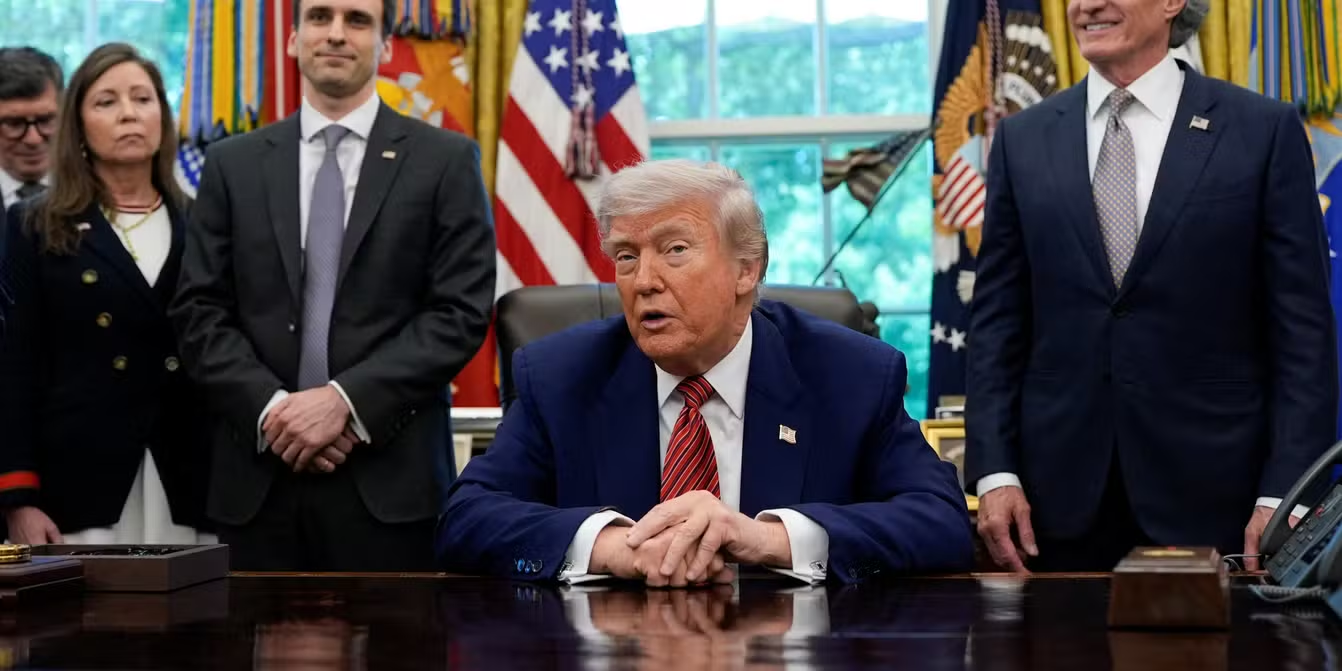
 Donald Trump is licensed under Creative Commons.
The landmark African Growth and Opportunity Act (AGOA) — a driving force of trade between sub-Saharan African and the United States —expired this September 30th, casting the future of the U.S.–Africa trade relationship has been cast into uncertainty. Over the last two decades AGOA has granted 32 Sub-Sharan African countries tariff-free access to the American market for most goods while they make progress toward protecting intellectual property rights, fighting corruption, eliminating child labor, and other reforms.
As trade increased, the nations of Africa became crucial sources of raw resources, intermediary inputs, and finished goods, establishing themselves as an irreplaceable stop on the supply chains of American manufacturers.
America’s competitors are set to benefit from AGOA’s expiring, with many having already taken note of Africa’s potential — scrambling to build a presence on the continent. China has notably grown its bilateral trade with Africa to a record $262 billion in 2023, making China by and large Africa’s most important trade partner — trading mostly in raw resources. China already owns or operates over 230 commercial ports in Africa, totaling a third of all maritime trade hubs. Without the carrot and stick incentives of AGOA promoting intellectual property rights, free-market reforms, and combatting corruption, China’s lead on the continent will only continue to grow.
AGOA was originally passed by Congress in 2000, backed by the Clinton Administration as a way to deepen ties with the African continent. The act sought to accomplish this by unilaterally granting duty-free trade status to African countries that met newly created eligibility requirements. Crucially, these requirements were set by each administration, making AGOA an adaptable tool for encouraging free-market reform on the continent and allowing the act to be integrated into broader diplomatic efforts.
Under AGOA, trade between the U.S. and Africa flourished. Since the act’s implementation in 2000, trade volume between the U.S. and AGOA-eligible countries has nearly tripled, peaking in 2008 at $82 billion, rebounding in 2011 to $78 billion, and later leveling off at roughly $30 billion in annual imports between 2019 and 2021.
Trade with African countries has become an important part of U.S. manufacturing: oil products comprise a large share of imports, while African exports of car parts, chemicals, and processed alloys have become crucial inputs for U.S. industry. Meanwhile, Africa has provided agricultural products and resources the U.S. is unable to produce.
While America’s competitors stand to gain, American partners in Africa will be heavily impacted. Under AGOA, several hubs for intermediate and finished goods, as well as specialty agriculture products were sustained in South Africa, Kenya, and other AGOA members. Without AGOA, these countries face much higher tariffs, isolating them from the American market. Vanilla from Madagascar will go from duty free status to 47% tariff, while Kenyan textiles, which were predominantly duty free under AGOA, will now face a tariff of 10% or more. Altogether 30,000 jobs in the textile sector across Africa are at risk, while in South Africa 35,000 jobs are at risk in the citrus producing industry alone. Consequences are dire for the industries built around AGOA: Pankaj Bedi, the CEO of the United Aryan clothing factory, a textile firm in Kenya remarked “If AGOA goes away we have zero chance to compete with the Asian countries. There is no way we can survive.”
Disrupted trade flows aren’t the only impact. Investment into Africa has more recently undergone a massive surge in foreign direct investment, with FDI reaching a record $97 billion (a 75% increase from the year prior) in 2024. This surge has been led by renewed interest in Africa’s mineral resource wealth, with African reserves of critical minerals such as copper, cobalt, lithium, and numerous others used in modern technologies — the largest reserves in the world.
Additionally, Africa hosts the world’s fastest-growing workforce, attracting manufacturers and service providers. The eligibility requirements of AGOA help enable this investment flow, giving assurances of political stability, respect for human rights, and pursuit of business-friendly, free-market reforms. Without the AGOA, these standards are gone in place of uncertainty.
The early successes of AGOA in the 2000s prompted a 10-year renewal in 2015. Unfortunately, these 10 years ended on September 30, 2025. Now AGOA joins the Miscellaneous Tariff Bill (MTB) and the Generalized System of Preferences (GSP) — both of which, prior to expiring in 2020, provided tariff relief to goods not produced domestically.
The lapsing of these two bills is already costing Americans, with the expiration of the GSP alone estimated to cost importers $2 billion annually. Allowing a similar fate to befall AGOA would be equally disruptive, upending decades of logistics networks, two-way trade growth, and U.S. diplomatic efforts.
The MTB and GSP didn’t end because of any real political opposition. Instead, a lack of urgency caused their renewal to quietly lapse, costing Americans billions. Allowing AGOA to expire without a suitable plan for the future of the U.S.-African trade relationship would leave the world’s fastest-growing region overlooked by U.S. policymakers and absent from future planning.
As African markets continue to grow, so too will their importance in global markets. Failing to craft a formal strategy to access these markets risks undermining the competitiveness of U.S. industries set to benefit most from U.S.-African trade, ceding ground to foreign competitors investing heavily in the continent’s future.