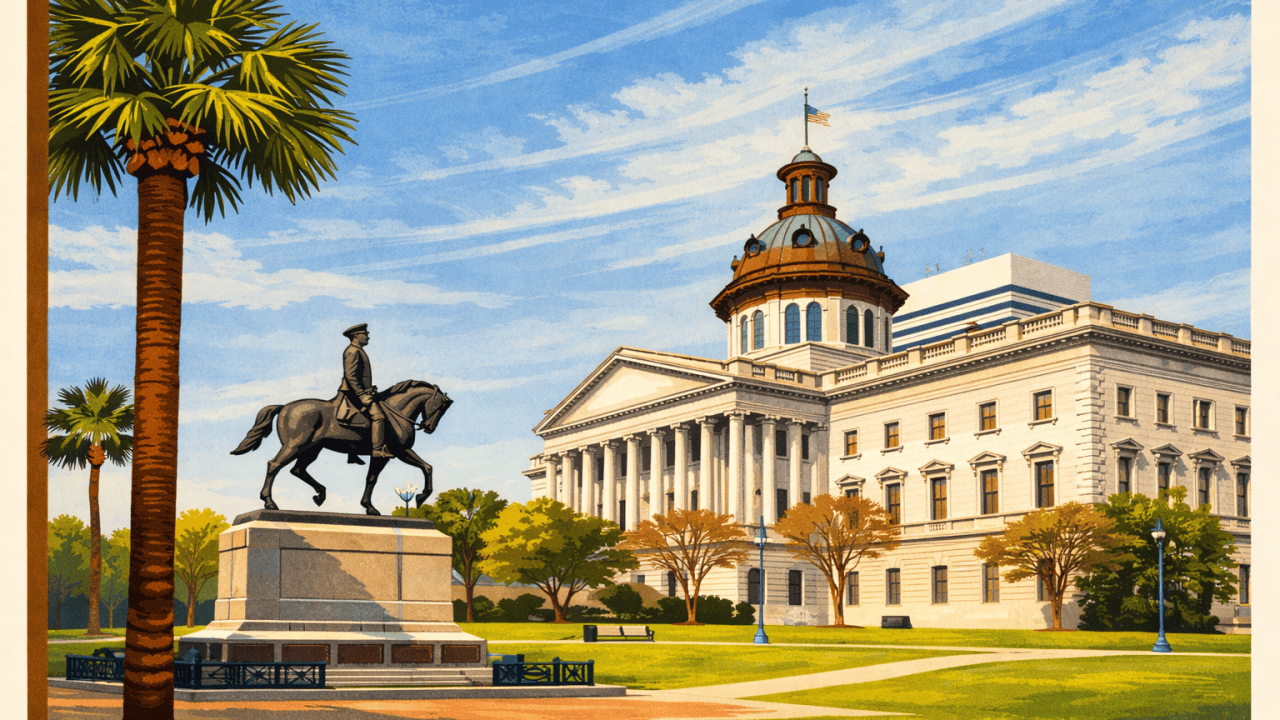
 SC Capitol Building
The first month of 2026 has featured a flurry of early-session activity in state legislatures, nearly all of which are now back in session. The most economically harmful proposals, such as California’s wealth tax initiative and the raft of tax hikes introduced by Virginia Democrats, are making national headlines, understandably so. Yet, while the most destructive proposals coming out of blue states are more likely to garner national media attention, there have also been many developments in state capitals over the first few weeks of 2026 that are cause for taxpayer celebration.
Take South Carolina, where more has been done to advance pro-growth policy so far this year than arguably any other state. Last week, the South Carolina Senate considered landmark reforms that would rein in tax and regulatory burdens across the Palmetto State and, if enacted, serve as a model for other states to emulate.
On Jan. 20, the South Carolina Senate Finance Committee held a hearing on H.4216, legislation passed by the House last year that would enact further income tax relief. H.4216 would immediately reduce the top marginal income tax rate from 6 percent to 5.39 percent, and then subsequently phase that down into a 1.99 percent single rate over the next five years. This bill also establishes revenue triggers that, if met, would fully phase out South Carolina’s income tax over time. Full elimination of the state income tax is a goal backed by all of the top contenders to be South Carolina’s next Governor.
Two days after the Senate Finance Committee advanced legislation to move South Carolina to a lower, single-rate income tax, the Senate Judiciary Committee held a subcommittee hearing on H.3021, the Small Business Regulatory Freedom Act. H.3021 is a REINS Act-style reform requiring that the most costly regulations receive approval from state legislators.
On top of requiring legislative approval for the most costly regulations, H.3021 includes a number of other pro-growth provisions that would alleviate regulatory burdens for South Carolina employers over time. As was noted in a coalition letter to South Carolina lawmakers to which ATR recently signed on, H.3021’s regulation review and sunset process would help state officials identify and eliminate outdated, duplicative, or unnecessary regulations.
“Taxes are only part of the deadweight cost of government,” said Grover Norquist, president of Americans for Tax Reform, at a Jan. 15 press conference at the South Carolina statehouse hosted by Americans for Prosperity. “Taxes are one of the big costs of government but the regulatory burden is sometimes even more difficult because you don’t see it.”
“People see it in the cost of everything they buy, that the world moves more slowly, that technology is adopted more slowly, that businesses start more slowly,” Norquist said, adding that enactment of H.3021 “will bring to light the cost and the opportunities to reduce the damage that overregulation does.”
In August of last year, North Carolina became the most recent state to adopt a state-level REINS Act, a reform that nearly a dozen states have enacted and which President Donald Trump has endorsed at the federal level. Unless H.3021 gets held up in the Senate Judiciary Committee, South Carolina is likely to soon join the growing ranks of states with a REINS Act-style law on the books.

As January comes to a close, nearly every state legislature is back in session. While mainstream media outlets are understandably focused on the unprecedented cash grabs sought by lawmakers in Sacramento, Richmond, Albany, Springfield, and other blue state capitals, there is plenty of good news for taxpayers coming out of red state capitals, perhaps none more so than South Carolina’s.