

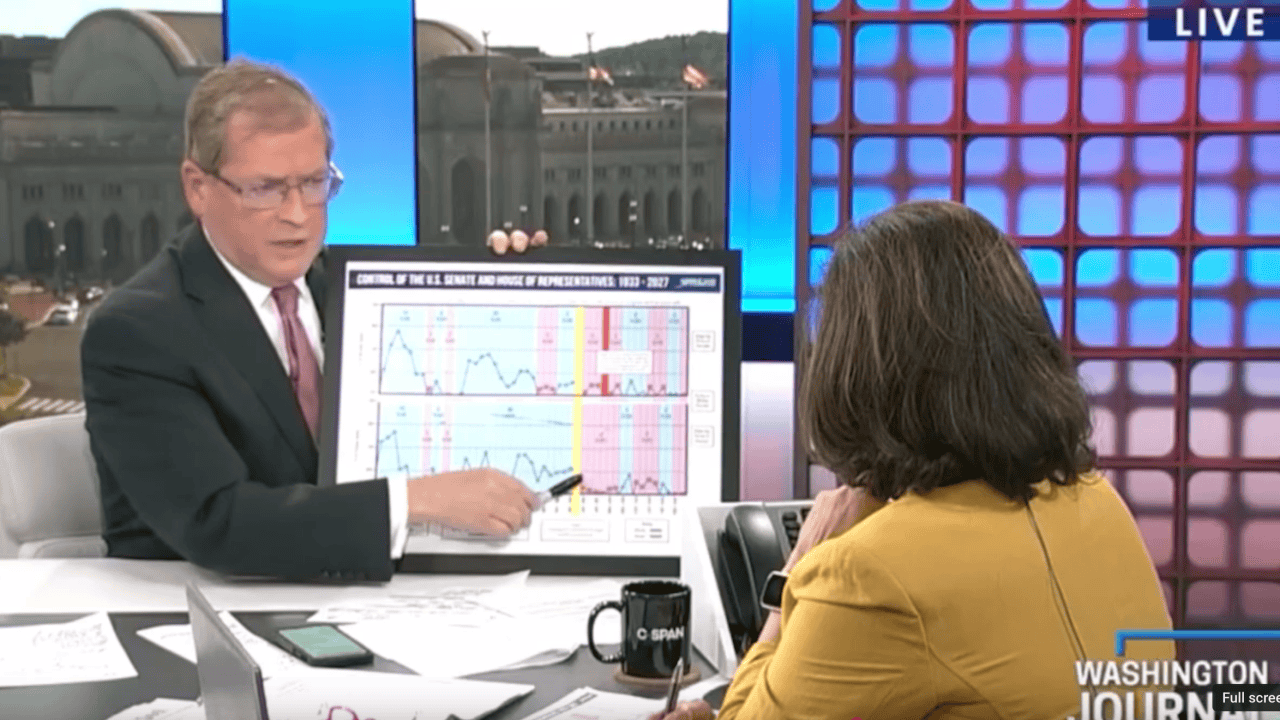
The Republican party became consistently competitive on the congressional level after it successfully branded itself as the party that would never raise your taxes.
Click here for a PDF of Grover’s famous yellow line chart which shows historical party control of the House and Senate from 1933 to the present day.
As Grover noted on C-SPAN Washington Journal:
For 62 years, from when Franklin Roosevelt was elected until 1994 when the Republicans swept the House and Senate, the Republicans controlled congress twice in 62 years. Once under Eisenhower, and once under Truman.
So we really had a one party state at the congressional level.
You could elect a Republican president, Eisenhower, Nixon, Reagan. They could veto things, but they can’t pass anything without the Democrat votes. So, here you had 62 years of one party rule in terms of Congress, who runs the country. Since 1994, this is when 96% of Republicans signed the Taxpayer Protection Pledge that Americans for Tax Reform shares with people. And that was in reaction to the fact that Bush had broken his pledge and raised taxes, and all the Republicans said, “We’re never doing that and it’s in writing. You can hold us responsible.”
And since then, the vast majority of Republicans, all the leadership has signed the pledge never to raise taxes. And since 1994, the Republicans have won both houses 18 years and the Democrats have run both houses six years. So the Republicans don’t have the dominance the Democrats had, but the parties are competitive and the Republicans have been on the field competitive only because they became the party that would never raise your taxes. They may invade small countries they can’t pronounce, which is how you end up losing Congress briefly here, but they will not raise your taxes.
And so the power of the tax issue and the answer, why did the president keep saying no to people saying, “We’ve got a great idea. Let’s raise taxes.” No. The difference between governing and not governing at all. So that’s, that’s the power in American politics of the tax issue.