
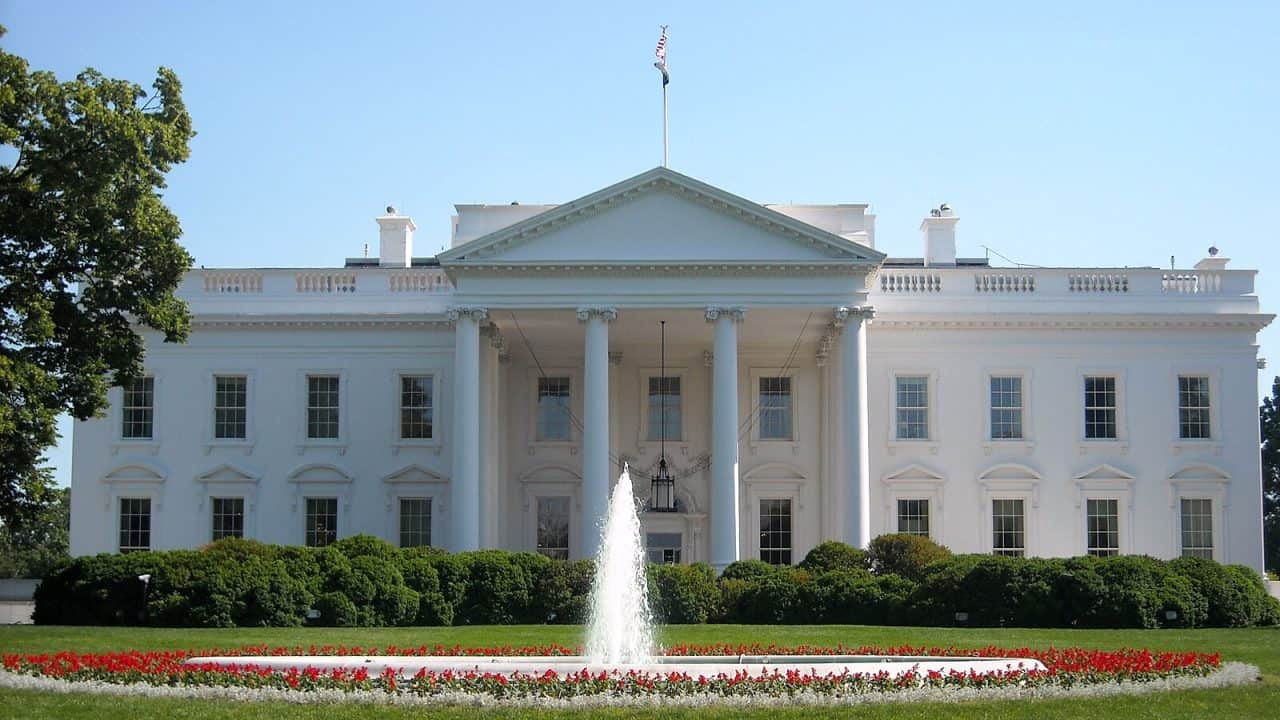
 White House DC is licensed under CC BY-SA 3.0

President Trump signed an executive order Thursday night that ends collective bargaining at federal agencies that have national security functions, a move long championed by Americans for Tax Reform.
With this new action, public-sector union bosses representing approximately 75 percent of the federal workforce will no longer be able to collectively bargain against the taxpayer. Agencies that will no longer participate in collective bargaining include the Department of Defense, Department of State, Department of Veterans Affairs, and Department of Justice, among many others.
The Executive Order, titled “Exclusions from Federal Labor-Management Relations Programs,” declares that the collective bargaining rights defined in Chapter 71 of title 5, U.S. Code, “cannot be applied to these agencies and agency subdivisions in a manner consistent with national security requirements and considerations.”
Section 7103(b)(1) of title 5, U.S. Code, says the President “may issue an order excluding any agency or subdivision thereof from coverage under this chapter if the President determines that (A) the agency or subdivision has as a primary function intelligence, counterintelligence, investigative, or national security work, and (B) the provisions of this chapter cannot be applied to that agency or subdivision in a manner consistent with national security requirements and considerations.” This provision was originally introduced as part of the Civil Service Reform Act of 1978.
Over the last decade, Americans for Tax Reform has advocated for using the authority granted to the President under 5 U.S.C. § 7103(b) to de-unionize federal agencies with national security functions. Most recently, ATR has been widely circulating a memo explaining how President Trump can use these powers to end collective bargaining at a number of agencies, with a central focus on the Department of Defense, the Department of Veterans Affairs, and the Transportation Security Administration (TSA).
The Washington Post covered this memo in January, noting that it had been “disseminated this month to congressional GOP leadership and incoming Trump aides.”
“One major roadblock to ensuring more efficient use of taxpayer resources is the control that large, public-sector labor union bosses hold over government agencies. Fortunately, the President has already been granted some powers to roll back this control,” the memo explained. “The administration can begin its effort to reduce government inefficiency by using the presidential powers to end obstructive collective bargaining efforts at agencies which deal with national security issues, as outlined in the Civil Service Reform Act of 1978.”
President Trump’s historic action on Thursday was the most sweeping use of these powers since the passage of the Civil Service Reform Act nearly 50 years ago. While almost every President since Jimmy Carter has used 5 U.S.C. § 7103(b) to end collective bargaining at certain small government subdivisions, President Trump’s action fulfills the intent of the law to remove obstructive unions from a much wider range of national security agencies.
Earlier this month, the Department of Homeland Security (DHS) announced an end to collective bargaining for the TSA’s Transportation Security Officers, citing the union’s protection of poor performers at the expense of American taxpayers and travelers. DHS revealed that nearly 200 TSA Officers have been receiving their taxpayer-funded salaries but perform full-time work on behalf of their union instead of doing work for the American people. This union subsidy, known as “official time,” is present in collective bargaining agreements across the government, squandering tax dollars on union activists who negotiate against the taxpayer.
President Trump’s action to end collective bargaining for the majority of federal workers will save taxpayers money, make the government more efficient, and make America safer by refocusing national security-related agencies on their core missions again.